
Energy-Efficient and Scheduling-Optimized Path Planning for Unmanned Transport Vehicles in Raspberry Cultivation
 ; Hyunjun Jung*
; Dongwon Jeong*
; Hyunjun Jung*
; Dongwon Jeong*
Abstract
Raspberry cultivation involves repetitive and labor-intensive transportation tasks, especially in multi-row orchard environments where unmanned transport vehicles must navigate within narrow row corridors and coordinate with workers distributed along different rows. To address these challenges, this study proposes the ZWJ algorithm, a multi-objective path planning and scheduling framework that jointly optimizes travel distance, load-aware energy consumption, and task completion time while supporting multi-worker collaboration. The algorithm incorporates cooperative task scheduling and a load-sensitive cost model to better adapt to row-constrained orchard layouts. Simulation results indicate that the proposed framework achieves improved performance trends compared to the baseline Greedy and A* methods under the evaluated raspberry cultivation scenarios.
초록
복분자 재배는 반복적이고 노동 집약적인 운송 작업을 수반하며, 특히 무인 운송 차량이 좁은 열 통로 내에서 이동하고 여러 열에 분산된 작업자와 협력해야 하는 다열 복분자 재배 환경에서 더욱 그렇다. 이러한 과제를 해결하기 위해 본 연구에서는 다중 작업자 협업을 지원하는 동시에 이동 거리, 부하 인식 에너지 소비, 작업 완료 시간을 공동으로 최적화하는 다목적 경로 계획 및 스케줄링 프레임워크인 ZWJ 알고리즘을 제안한다. 이 알고리즘은 협력 작업 스케줄링과 부하 민감 비용 모델을 통합하여 제약이 있는 복분자 재배 환경에 더욱 효과적으로 적응한다. 시뮬레이션 결과는 제안된 프레임워크가 평가된 복분자 재배 시나리오에서 기준이 되는 Greedy 및 A* 알고리즘에 비해 향상된 성능을 보였다.
Keywords:
raspberry cultivation, unmanned transport vehicle, autonomous driving, path planning, multi-objective optimization, multi-worker cooperative scheduling, ZWJ algorithmⅠ. Introduction
Transportation plays a critical role in agricultural harvesting[1]. With the aging agricultural workforce, manual fruit handling has become increasingly inefficient[2]. In raspberry cultivation, the high moisture content and heavy weight of harvested fruits add additional physical burden[3], particularly for elderly farmers, and the demand for agricultural robots capable of replacing labor-intensive transport tasks is steadily increasing[4][5], especially in multi-row orchard environments where repetitive load carrying is unavoidable.
Raspberry orchards typically adopt a long and narrow multi-row planting structure[6]. As shown in Fig. 1, multiple crop rows are arranged in parallel, separated by narrow inter-row corridors. Workers operate along both sides of each row, resulting in harvesting tasks that are linearly distributed rather than uniformly scattered across the field. This spatial layout restricts the movement of unmanned transport vehicles, which must travel strictly within the row corridors and switch between rows only via headland turning areas[7][8]. These structural characteristics make path planning significantly more challenging than in open-field environments, as the vehicle must navigate under row-based constraints while coordinating with workers positioned at different locations[9][10]. Figure 1(a) shows the real raspberry orchard with dense multi-row vegetation, while Figure 1(b) provides a schematic layout highlighting plant rows, inter-row corridors, headland turning areas, and the distribution of workers. The unmanned transport vehicle’s navigation is thus constrained by this structured layout and must account for cooperative interactions with multiple workers[11].
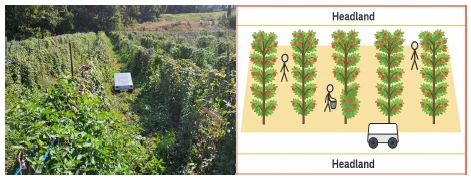
Raspberry cultivation environment
Existing studies related to agricultural transporation planning can be broadly grouped into four categories: path planning methods in agricultural environments, load or energy-aware routing approaches, multi-worker task assignment and scheduling strategies, and joint planning and scheduling frameworks.
In the first category, traditional algorithms such as A*[12] primarily focus on minimizing travel distance and do not incorporate load-aware energy consumption or multi-worker coordination[13][14]. From the perspective of the second and third categories, Greedy[15] heuristics are computationally efficient but lack global optimality, and their limitations become more pronounced under the row-constrained orchard structure. As a result, existing path planning approaches often generate unnecessary cross-row movements, inefficient turning behavior, or suboptimal worker service sequencing in multi-worker scenarios. Across these four categories, existing approaches exhibit notable limitations when applied to multi-row raspberry cultivation environments characterized by narrow inter-row corridors and restricted headland turning, as they typically address routing, energy modeling, or task scheduling in isolation rather than in an integrated manner.
To address these challenges, this study proposes the ZWJ algorithm, originally named MA*+MWCS (Multi-Objective A* + Multi-Worker Cooperative Scheduling). For clarity, the method is referred to as the ZWJ algorithm throughout this paper. The proposed approach integrates load-aware path planning and multi-worker cooperative scheduling within a unified, problem-driven framework, jointly considering travel distance, energy consumption, and task completion time under the motion constraints imposed by multi-row orchard environments. Rather than introducing a fundamentally new search algorithm, this work focuses on systematically combining existing planning and scheduling components to better reflect the practical constraints of raspberry cultivation fields.
Ⅱ. Methodology
In this section, the proposed algorithmic framework for unmanned transport vehicle scheduling and path planning in raspberry cultivation environments is introduced. Building upon the multi-row orchard characteristics discussed in Section 1, the methodology highlights how the ZWJ algorithm is specifically designed to address row-constrained navigation and multi-worker collaboration.
2.1 Orchard-specific motion constraints
Raspberry orchards impose unique structural constraints on vehicle movement.
The unmanned transport vehicle must (i) travel strictly within narrow inter-row corridors, (ii) switch rows only via headland turning areas, and (iii) serve workers whose picking positions are linearly distributed along plant rows.
These characteristics result in zigzag navigation patterns, non-uniform task locations, and load-dependent energy variations, all of which must be explicitly accounted for in the planning process.
2.2 Algorithm overview
The proposed MA*-MWCS (Multi-Objective A* + Multi-Worker Cooperative Scheduling)—referred to as the ZWJ algorithm—combines multi-objective A* path planning with cooperative task scheduling for multiple workers. It jointly optimizes path distance, load-aware energy consumption, and transportation time, enabling efficient coordination under vehicle load constraints. In this study, worker positions are assumed to remain static within a single planning cycle, allowing the analysis to focus on the core characteristics of the proposed joint optimization framework.
2.3 System architecture
The overall framework of the MA*-MWCS system is illustrated in Fig. 2.It consists of three layers: Input, Processing, and Output.
- ● Input: includes the worker set(w1,w2,w3),task set(t1...t6), and vehicle parameters such as maximum load (15 kg).
- ● Processing: contains three modules—Task Assignment, Sequence Optimization, and Path Planning.
- ● Output: generates optimal task assignment, visiting sequence, and a load-aware path minimizing total distance, energy, and time.
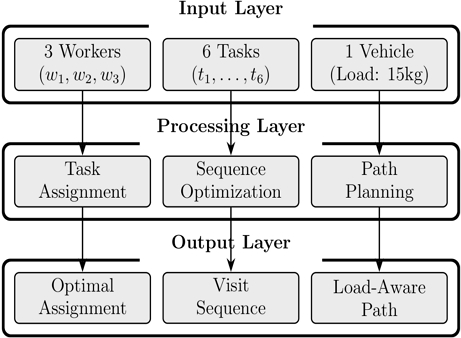
MA*-MWCS(ZWJ) system architecture
2.4 Core modules
- ● Task Assignment
Tasks are allocated considering worker proximity and vehicle capacity to reduce unnecessary travel and avoid overload. This yields a balanced distribution for subsequent scheduling.
- ● Sequence Optimization
Given the assigned tasks, the visiting order is optimized to maintain high efficiency while balancing distance, energy, and time.
- ● Path Planning
In this stage, the framework integrates the global optimization objective with the improved A* search implementation.
The overall multi-objective optimization is defined by Eq. (1):
| (1) |
Where Cd(S), Ce(S) and Ct(S) denote total distance, energy consumption, and α, β, and γ are their weights.
The improved A* algorithm introduces a load-related penalty term into the traditional cost function to account for the vehicle’s carrying load, formulated as: (Eq. (2)):
| (2) |
where g(n) denotes the accumulated cost from the start node to node h(n) is the heuristic distance to the goal, L is the current vehicle load, λ is the global load penalty coefficient, and μ is the local adjustment factor controlling load sensitivity.
This modification enables the algorithm to dynamically balance path distance and energy consumption during route selection, achieving more efficient navigation under varying load conditions.
Eq. (1) defines what the system minimizes (distance / energy / time), while Eq. (2) defines how the search achieves it through a load-aware A* cost.
This design enables the vehicle to balance energy and time efficiency under load constraints, achieving smoother and more efficient navigation in the orchard environment.
Ⅲ. Experiments and Results
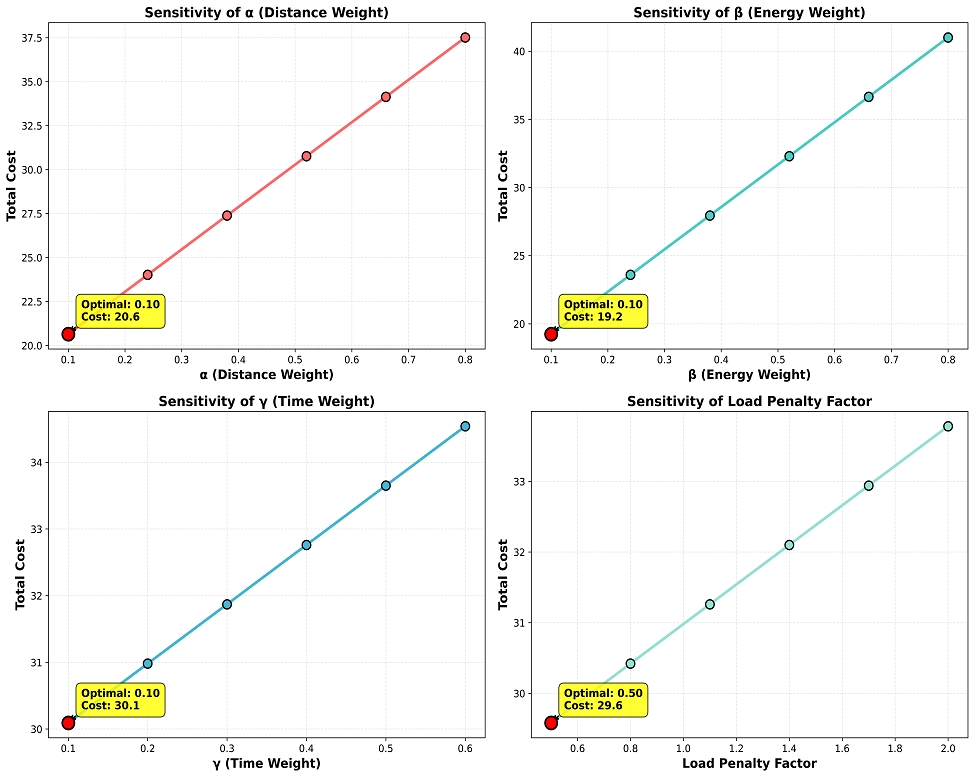
The experimental settings are shown in Table 1. Three worker configurations (1, 2, and 3) were tested under different task loads (3, 6, and 9 tasks). The maximum vehicle load was set to 15 kg. Parameter sensitivity was analyzed for α (distance weight), β (energy weight), γ (time weight), and λ (load penalty factor), with E0 = 1.0, η = 0.1, and vmax = 5m/s. The simulated map consisted of a 25×20 grid representing the raspberry orchard layout, including planting rows and headland turning zones. Three algorithms ZWJ (MA*-MWCS), Greedy, and Baseline A* were compared under identical experimental conditions.

Experimental setup
Fig. 3 shows the layout of the raspberry orchard used for simulation, where three workers are distributed along planting rows and the vehicle load limit is set to 15 kg. This environment provides realistic conditions for evaluating task assignment and path planning.
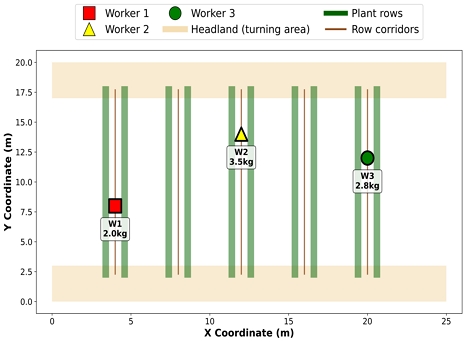
Multi-worker distribution in raspberry orchard (Workers=3, max_load=15kg)
Fig. 4 compares the vehicle paths produced by the ZWJ Algorithm, Greedy, and Baseline A* in the same orchard scenario. The ZWJ Algorithm follows a structured “Z-shaped” route along planting rows, minimizing cross-row transitions and redundant turns. The Greedy method repeatedly selects the nearest task, causing extra lateral movement and longer distance, while Baseline A* yields inefficient detours across rows. Overall, ZWJ demonstrates smoother navigation and better adaptability to the row-based structure, achieving shorter total distance and lower energy cost. This behavior results from the load-aware penalty incorporated into the A* cost function in Eq. (2), which discourages long-distance travel under high load and promotes earlier unloading along the planting rows.
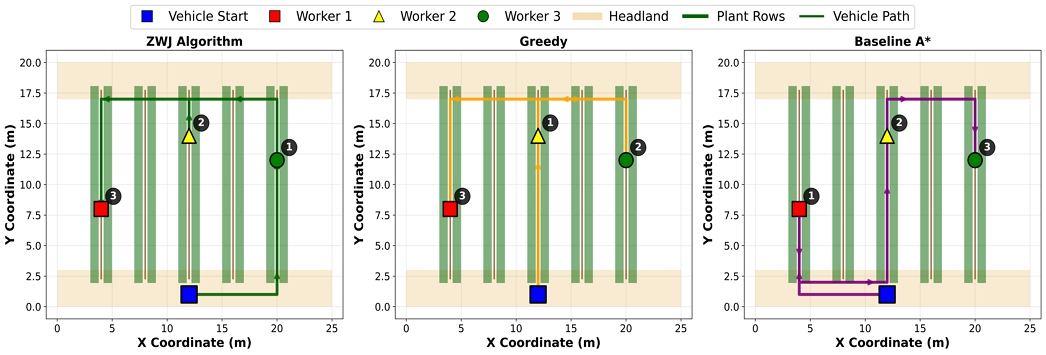
Path planning comparison in orchard environment (Zigzag paths along plant rows)
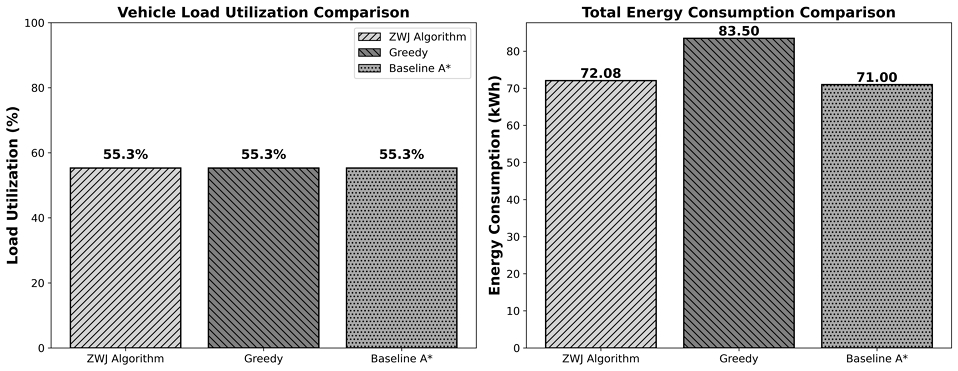
Fig. 5 summarizes load utilization and energy consumption. All algorithms reach a similar load ratio (≈55%), but ZWJ consumes only 72.08 kWh, less than 83.5 kWh for Greedy, confirming better energy–distance balance.
Load/energy analysis (Workers=3,max_load=15kg)
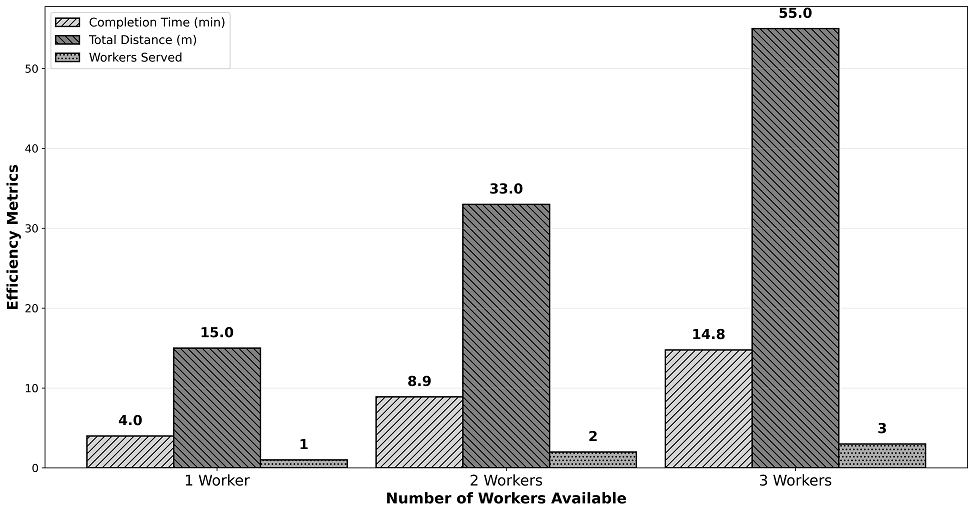
Fig. 6 illustrates how task completion time and total travel distance of the proposed ZWJ framework vary under different worker configurations. As the number of workers increases from one to three, the total completion time increases due to a larger number of tasks being handled simultaneously. Meanwhile, the travel distance grows in a controlled manner, indicating that task coordination remains stable within the evaluated worker range.
Effect of worker number on task completion behavior in the ZWJ framework (Max_load=15kg)
It should be noted that this experiment is intended to analyze the internal task coordination behavior of the proposed framework under different worker configurations, rather than to provide a cross-algorithm performance comparison.
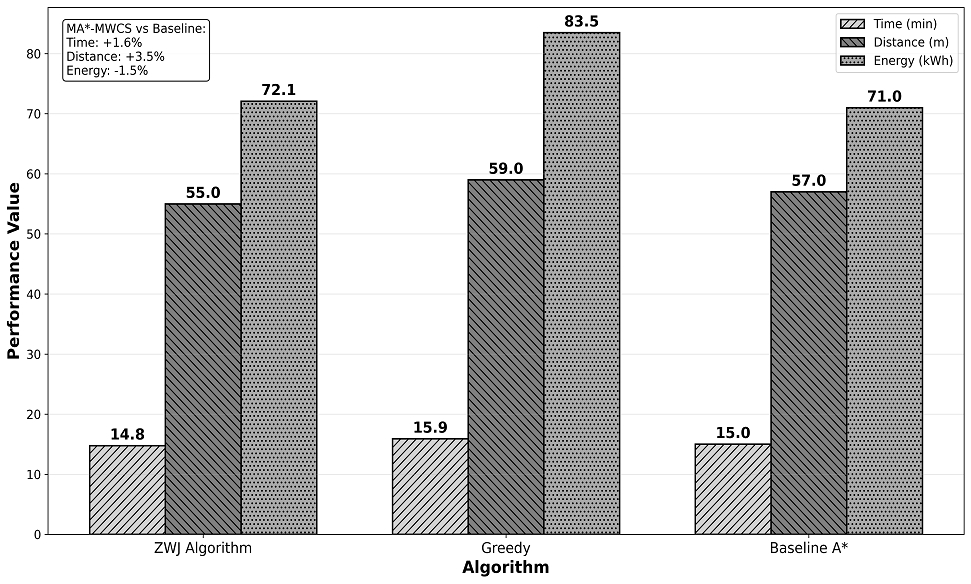
Fig. 7 aggregates performance metrics (time, distance, energy), showing that ZWJ slightly outperforms Baseline A* and clearly surpasses Greedy across all objectives.
Comprehensive performance metrics comparison (Workers=3, max_load=15kg, lower is better)
Fig. 8 presents parameter sensitivity for α, β, γ, and λ; The results exhibit near-linear trends within the evaluated parameter ranges, suggesting that the behavior of the MA*-MWCS framework is relatively stable under moderate parameter variations in the tested scenario.
Parameter sensitivity analysis for MA*-MWCS algorithm (workers=3, max_load=15kg)
Ⅳ. Conclusion
This study presented a joint planning and scheduling framework for unmanned transport vehicles operating in multi-row raspberry cultivation environments. By explicitly considering orchard-specific motion constraints, such as narrow inter-row corridors and restricted headland turning areas, the proposed ZWJ framework integrates load-aware path planning with multi-worker cooperative scheduling to jointly address travel distance, energy consumption, and task completion time.
Experimental results in a representative orchard scenario demonstrate that the proposed framework produces more structured routing behavior and balanced task execution compared to baseline Greedy and A* approaches. Rather than relying solely on shortest-path criteria, the load-aware cost formulation guides the vehicle to avoid inefficient high-load movements, while the cooperative scheduling mechanism reduces redundant travel and improves coordination among multiple workers. These mechanisms together explain the observed improvements in energy consumption and task completion characteristics under the evaluated settings.
It should be noted that the experimental evaluation in this study is conducted under limited field scale and static worker assumptions, with the primary objective of analyzing the core behavior of the proposed framework. The worker positions and harvesting rates are assumed to remain fixed within a planning cycle to facilitate clear interpretation of the planning and scheduling interactions.
Future work will focus on extending the proposed framework toward more realistic and large-scale orchard scenarios. In practical farming environments, workers may change locations and exhibit varying harvesting speeds over time, and larger orchards may involve more complex task distributions. To address these challenges, future research will incorporate dynamic worker modeling, perception feedback, and online task replanning, as well as evaluate the framework under larger-scale and more complex orchard layouts. These extensions aim to further enhance the applicability and robustness of the proposed framework for real-world agricultural deployment.
References
-
X M. Nørremark, R. S. Nilsson, and C. A. G. Sørensen, "In-Field Route Planning Optimisation and Performance Indicators of Grain Harvest Operations", Agronomy, Vol. 12, No. 5, Article No. 1151, Dec. 2022.
[https://doi.org/10.3390/agronomy12051151]

- S. S. Lee, "Agricultural, Forestry, and Fisheries Survey Results", KOSTAT, Apr. 2022.
-
N. Bogomolova, S. Rezvyakova, and M. Lupin, "Study of density of raspberry fruits in view of mechanized harvesting", E3S Web of Conferences, Vol. 247, Article No. 01045, Jan. 2021.
[https://doi.org/10.1051/e3sconf/202124701045]
- D. H. Lee and G. H. Kim, "Current and Future Robot Technologies in Open-field Agriculture", The Journal of The Korean Institute of Communication Sciences, Vol. 39, No. 10, pp. 13-18, Sep. 2022.
-
K. B. Lee, et al., "Implementation of 3D Location Detection Embedded System for Tomato Harvesting Robots", The Journal of Korean Institute of Communications and Information Sciences, Vol. 47, No. 11, pp. 2007-2019, Nov. 2022.
[https://doi.org/10.7840/kics.2022.47.11.2007]
-
G. Gim, B.-W. On, S. Lee, Y. Lee, H. Jung, and D. Jeong, "YOLOv5 and LiDAR-based Autonomous Driving System for Agricultural Produce Transportation in the Cultivation Environment of Rubus Coreanus", The Journal of Korean Institute of Information Technology, Vol. 21, No. 12, pp. 99-107, Dec. 2023.
[https://doi.org/10.14801/jkiit.2023.21.12.99]
-
Z. Fei and S. Vougioukas, "Row-sensing templates: A generic 3D sensor-based approach to robot localization with respect to orchard row centerlines", Journal of Field Robotics, Vol. 39, No. 6, pp. 712-738, Jul. 2022.
[https://doi.org/10.1002/rob.22072]
-
Z. He, et al., "Dynamic path planning method for headland turning of unmanned agricultural vehicles", Computers and Electronics in Agriculture, Vol. 206, Article No. 107699, Mar. 2023.
[https://doi.org/10.1016/j.compag.2023.107699]
-
J. Longteng, R. Chiruijuan, Y. Mayueqi, N. Dong, X. Huang, C. Ban, and X. Zhu, "Research on path planning method of agricultural robot based on grid method", Journal of Agricultural Mechanization Research, Vol. 46, No. 6, pp. 19-24, Jun. 2024.
[https://doi.org/10.13427/j.cnki.njyi.2024.06.001]
-
Z. Sun, S. Tang, X. Luo, J. Dong, N. Xu, C. Ban, and X. Zhu, "Current research and application status of path planning for agricultural inspection robots", Agricultural Equipment and Vehicle Engineering, Vol. 63, No. 1, pp. 18-24, Jan. 2025.
[https://doi.org/10.3969/j.issn.1673-3142.2025.01.003]
-
A. R. Sadik, A. Taramov, and B. Urban, "Optimization of tasks scheduling in cooperative robotics manufacturing via Johnson's algorithm case-study: One collaborative robot in cooperation with two workers", Proc. 2017 IEEE Conference on Systems, Process and Control (ICSPC), Meleka, Malaysia, pp. 36-41, Dec. 2017.
[https://doi.org/10.1109/SPC.2017.8313018]
-
P. E. Hart, N. J. Nilsson, and B. Raphael, "A formal basis for the heuristic determination of minimum cost paths", IEEE Transactions on Systems Science and Cybernetics, Vol. 4, No. 2, pp. 100-107, Jul. 1968.
[https://doi.org/10.1109/TSSC.1968.300136]
-
F. Duchoň, A. Babinec, M. Kajan, P. Beňo, M. Florek, T. Fico, and L. Jurišica, "Path Planning with Modified A Star Algorithm for a Mobile Robot", Procedia Engineering, Vol. 96, pp. 59-69, Dec. 2014.
[https://doi.org/10.1016/j.proeng.2014.12.098]
-
S. Liu and D. Sun, "Minimizing energy consumption of wheeled mobile robots via optimal motion planning", IEEE/ASME Transactions on Mechatronics, Vol. 19, No. 2, pp. 401-411, Apr. 2013.
[https://doi.org/10.1109/TMECH.2013.2241777]
- Greedy algorithm, https://en.wikipedia.org/wiki/Greedy_algorithm, . [accessed: Oct. 21. 2025]

2024. 3 : B.S. Engineering, Dept. of Software Science & Engineering, Kunsan National University
2024. 9 ~ Present : Master's Program, Dept. of Software Convergence Engineering, Kunsan National University
Research Interests : Autonomous Driving, Path Planning, Multi-objective Optimization, Artificial Intelligence

2008. 3 : B.S. Engineering, Dept. of Computer Science, Sahmyook University
2010. 3 : M.S. Engineering, Dept. of Computer Science, Soongsil University
2017. 9 : Ph.D. Engineering, Dept. of Computer and Radio Communications Engineering, Korea University
2017. 8 ~ 2020. 8 : Gwangju Institute of Science and Technology Researcher, Blockchain Internet Economy Research Center
2021. 3 ~ Present : Associate Professor, Dept. of Software Science & Engineering, Kunsan National University
Research Interests : Blockchain, Data Science, Sensor Networks, Internet of Things, Machine Learning

1997. 2 : B.S. degree, Dept. of Computer Science, Kunsan National University
1999. 2 : M.S. degree, Dept. of Computer Science, Chungbuk National University
2004. 2 : Ph.D degree., Dept. of Computer Science & Engineering, Korea University
2005. 3 ~ Present : Professor, Dept. of Software Science & Engineering, Kunsan National University
Research Interests : Databases, Semantic Services, Big Data, Internet of Things, Edge Computing, Intelligent Convergence Services