
Robust Gait-based User Authentication in Real-World Environments using CNN and Data Augmentation
 ; Sangil Choi*
; Taewon Kang*
; Sangil Choi*
; Taewon Kang*
Abstract
Gait patterns, inherently unique to individuals, have emerged as a promising modality for user authentication on smart devices. However, most previous studies were based on data collected in controlled environments, limiting their applicability in real environments. This study analyzed gait-based user authentication using the ETRI Lifelog dataset, which contains data collected by smartphone sensors in real-world everyday environments. We evaluated the authentication performance for both walking and running activities using a CNN-based gait authentication system, and four data augmentation techniques, including noise addition and spatiotemporal transformation, were applied to compensate for imbalance and performance degradation in running activities. As a result, the system achieved an authentication accuracy of approximately 93%, demonstrating improved robustness across heterogeneous activity contexts. These findings underscore the importance of real-world data and augmentation strategies in enhancing the generalization of gait-based authentication models.
초록
개인의 고유한 특성을 반영하는 보행 패턴은 사용자 인증을 위한 유망한 생체 정보로 주목받고 있다. 그러나 기존 연구는 대부분 통제된 환경에서 수집된 데이터를 기반으로 수행되어, 실제 환경에서의 적용 가능성에 한계가 있었다. 본 연구는 현실 세계의 일상 환경에서 스마트폰으로 수집된 데이터를 포함하는 ETRI Lifelog 데이터셋을 활용하여 보행 기반 사용자 인증을 분석하였다. 보행 및 달리기 활동에 대한 인증 성능은 CNN 기반 보행 인증 시스템을 활용하여 평가하였으며, 달리기 활동에서의 불균형과 성능 저하를 보완하기 위해 노이즈 추가 및 시공간 변환을 포함한 4가지 데이터 증강 기법을 적용하였다. 그 결과, 약 93%의 인증 정확도를 확보하였으며, 다양한 활동 상황에서도 모델의 강건성이 향상됨을 확인할 수 있었다. 본 연구는 현실 환경 기반 데이터와 데이터 증강 전략이 보행 기반 인증 모델의 일반화 성능을 향상하는 데 중요한 역할을 할 수 있음을 보여준다.
Keywords:
human gait, convolutional neural network, authentication, machine learning, robustnessⅠ. Introduction
Human biometrics are widely used for security and authentication, offering unique features that distinguish individuals [1]. Among them, gait patterns have drawn attention due to their ease of acquisition via smart devices and the potential for continuous collection [2].
However, previous researches on gait authentication have primarily used data collected under constrained conditions—fixed sensor positions, flat surfaces, or only walking activities—limiting applicability to real-world settings where activity types, ground conditions, and sensor placements are constantly changing [3]. In particular, transitions from walking to running can significantly affect gait characteristics and degrade authentication accuracy.
This study investigates the robustness of gait-based authentication under uncontrolled, real-world conditions using the ETRI Lifelog dataset [4] to address these issues. The dataset includes gait data collected from daily life, including walking and running activities. A CNN-based authentication model was used to assess performance variations across activities. Experimental results show that authentication performance varies even for the same individual depending on the activity type. In order to reduce this variability, we apply data augmentation techniques such as noise injection and temporal-spatial transformations to enrich the dataset and improve the model’s generalization.
This study contributes to the advancement of gait-based authentication by analyzing performance under real-world conditions and demonstrating the efficacy of data augmentation in improving model robustness. Specifically, our contributions are threefold: (1) we utilize real-world gait data from the ETRI Lifelog dataset to enhance ecological validity, (2) we conduct an activity-specific analysis highlighting performance disparities between walking and running, and (3) we apply data augmentation to address class imbalance, achieving improved accuracy, particularly for underrepresented running activities.
The remainder of this paper is organized as follows. Chapter 2 reviews related work on gait authentication. Chapter 3 presents the dataset, preprocessing methods, model architecture, and training setup. Chapter 4 presents the authentication results, and Chapter 5 analyzes the effects of data augmentation. Finally, Chapter 6 summarizes our findings and discusses directions for future work.
Ⅱ. Related Works
With the advancement of smartphone sensor technology, there has been a surge in research related to gait-based identification. A notable trend in biometric authentication is the utilization of an individual's unique gait pattern as an authentication. This chapter provides an overview of the fundamental concepts of gait-based identification, recent research trends, existing challenges, and prospects. The uniqueness of gait patterns has been recognized as a potent tool in biometric authentication [5]-[9]. Initially, research centered around basic sensors such as accelerometers and gyroscopes. However, recent studies emphasize enhancing gait identification accuracy by using various sensors and sensor fusion techniques [10]-[12].
The emergence of deep learning has brought significant changes to the gait gait analysis field. Deep learning models utilizing RNN-based CNNs or LSTMs to analyze spatial and temporal patterns of sensor data, substantially improved gait identification accuracy [13][14]. Among these, CNNs have been widely employed for authentication or identification in numerous studies. In comparing models trained with feature maps extracted by CNNs to models trained with typical statistical features, CNNs outperformed other algorithms by more than 10% [15].
Evaluating performance in the real world is considerably more crucial than theoretical research. This is because various situations in the real world can significantly affect the performance of gait gait-based identification [16][17]. However, many existing gait-related research datasets have been collected under limited environments. Notable datasets include public datasets like RecodGait [10], OU-ISIR [10][11][15], ZJU-GaitAcc [13], WISDM [9][12][14], and HMOG [12][18]. For instance, the OU-ISIR dataset was limited by collecting data on treadmills, and the WISDM dataset had fixed inertial sensor positions on the body. In addition, research using public datasets often had constraints, such as fixed sensor positions [16]-[20] or data collected under specific experimental conditions [21][22]. These limitations may not adequately reflect a variety of real-world environments, limiting the practical applicability of the authentication feature. This study was conducted to overcome these limitations and systematically evaluate gait gait-based authentication performance based on data closer to the real world. We aim to determine how an authentication model trained on an individual's gait data responds to different activity types (e.g., walking, running) and what variability exists in its performance.
Ⅲ. Data and Model Configuration
We used a subset of the publicly available ETRI Lifelog dataset, which includes multi-modal sensor data collected from 72 participants between 2018 and 2020 in uncontrolled, real-world settings. While the full dataset spans approximately 14,220 hours of activity logs from smartphones and wearable devices, including IMU, GPS, PPG, EDA, and thermal sensors, we focused exclusively on smartphone-based triaxial acceleration (m/s², 30 Hz) and gyroscope data (rad/s, degrees, 30 Hz) for gait authentication.
In order to ensure data quality and consistency, we applied standard preprocessing steps, including data cleaning, interpolation, noise filtering, and window segmentation. These addressed labeling errors, irregular sampling, and environmental noise, yielding fixed-length gait segments (1.8 seconds) for model training. Figure 1 shows acceleration data from the same individual: the left side highlights regular gait patterns (black boxes), while the right side shows irregular or missing segments caused by sensor noise, data loss, or non-gait activity, underscoring the need for robust preprocessing. After removing incomplete, mislabeled, or distorted segments, data from only 10 participants were retained. The final dataset focused on walking and running activities across varied locations (e.g., home, workplace, outdoor), as defined in Table 1 and summarized in Table 2. Preprocessing followed our prior methodology in [22].
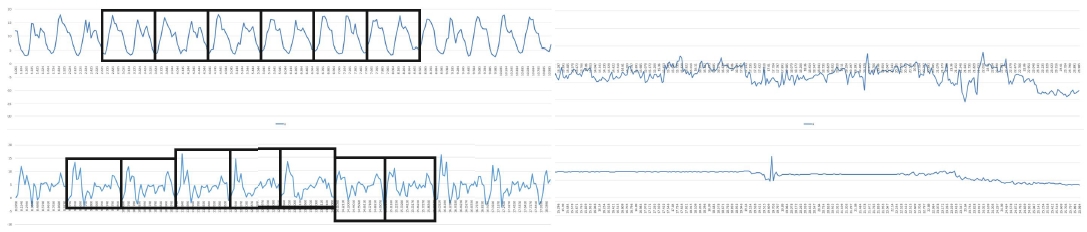
Acceleration labeled as walking

Conditions of dataset [4]
Model configuration [22]
Our research employs a CNN for the authentication of individuals based on their gait patterns. Designed to process inertial time-series data, the model uses a 1D CNN architecture to effectively extract temporal features from windowed gait sequences.
The overall structure comprises sequential convolution, pooling, and dropout layers, followed by a dense output layer with softmax activation for user classification. This configuration was chosen for its ability to capture essential gait characteristics while minimizing overfitting and ensuring stable learning. The final model outputs the probability that an input sequence belongs to a legitimate user. Table 2 presents the detailed configuration of the model used in this study.
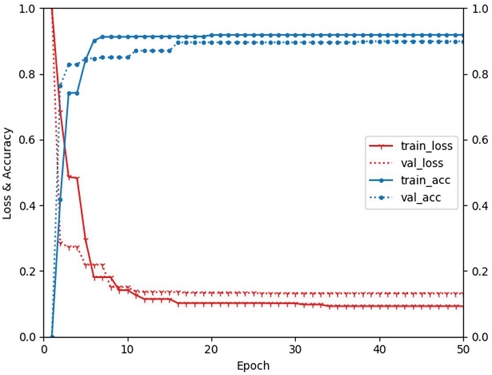
Data segmentation was performed using Scikit-learn's train_test_split() function, with 60% of the total data allocated for training and the remaining 40% for testing. During this segmentation, the shuffle parameter was set to true to randomly mix the data, which minimizes bias and improves generalization. For training, we utilized Tensor-Flow's ModelCheckpoint() function to evaluate the model's performance at each epoch and save it only if it outperformed the previous one, thus preserving the optimal model. The model's training process and performance are visually represented in Figure 2.
Loss and accuracy of training and validation
The model achieved approximately 92% accuracy on the training dataset and maintained close to 91% accuracy on the validation dataset. These results demonstrate the model's stable accuracy and reliability in gait authentication performance.
Ⅳ. Real-World Authentication Results
In this chapter, we evaluate the authentication performance of the CNN-based model developed in Chapter 3 by analyzing its ability to distinguish individuals based on walking and running patterns. We use four standard evaluation metrics—accuracy, precision, recall, and F1-score—defined based on true positives (TP), false negatives (FN), false positives (FP), and true negatives (TN).
Table 3 summarizes the performance results for 10 users. The overall average accuracy across both activity types is 0.906. When broken down by activity, the model achieved 0.959 accuracy for walking and 0.861 for running. A similar pattern is observed for the other metrics: the average recall, precision, and F1-score for walking are 0.948, 0.960, and 0.954, respectively, while for running, the values drop to 0.683, 0.712, and 0.697. Notably, the F1-score for running is substantially lower than for walking, indicating reduced performance in that activity. This performance gap may be attributed to two factors. First, the dataset contains significantly more walking samples than running samples, which may have biased the model toward walking patterns. Second, the model may have overfitted to walking data, which limits its ability to generalize to running activities, especially given the insufficient representation of running data in the training set.
Authentication result
This limitation highlights the model’s difficulty in generalizing across different activity types in real-world scenarios and may lead to increased authentication errors, particularly when user motion deviates from typical walking patterns. Such shortcomings are critical in applications like security systems and healthcare, where consistent performance is essential. Addressing this issue requires enhancing the model’s robustness and ensuring a more balanced representation of diverse activity types within the dataset.
Ⅴ. Effect of Data Augmentation
Based on the findings in Chapter 4, we confirmed that authentication performance declines when transitioning between activity types, even for the same individual. This degradation is primarily attributed to data imbalance, as the quantity of running data is significantly lower than walking data, as shown in Table 2. Furthermore, since the ETRI Lifelog dataset is publicly available, it cannot be expanded through additional data collection. To address this, we applied data augmentation to increase the diversity of training samples and enhance model generalization.
5.1 Data augmentation
Data augmentation is a widely used technique for improving model robustness by artificially expanding the training dataset. In this study, we applied four augmentation strategies based on 1D signal processing: (1) additive noise, which perturbs the magnitude of gait signals to simulate real-world noise; (2) temporal shifts, which randomly displace signals to introduce phase variation; and (3) vertical and horizontal stretching, which rescale the signal in magnitude and time domains to mimic gait variations. These transformations were applied randomly with up to 15% distortion, as illustrated in Figure 3.
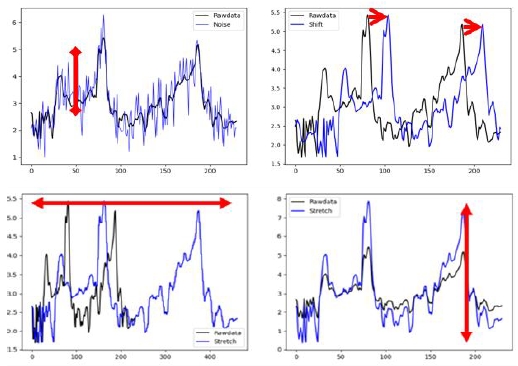
Gait data authentication methods
Table 4 presents the authentication results before and after augmentation. Notably, performance improvements were observed across most metrics, particularly for the running activity, which had previously shown reduced accuracy due to data imbalance.
Authentication results before and after balancing data
5.2 Performance evaluation after augmentation
We evaluated the model trained with augmented data using the same metrics as in Chapter 4—accuracy, precision, recall, and F1-score. As summarized in Table 4 and visualized in Figure 4, the overall average accuracy increased from 0.906 to 0.928 after augmentation. Notably, accuracy for running activities improved from 0.861 to 0.904 (+4.3%), while walking accuracy slightly decreased from 0.959 to 0.957 (-0.2%). Although the improvement in average accuracy may appear modest, gains for running activities ranged from 2% to 7%, demonstrating the effectiveness of the applied augmentation techniques in addressing class imbalance.
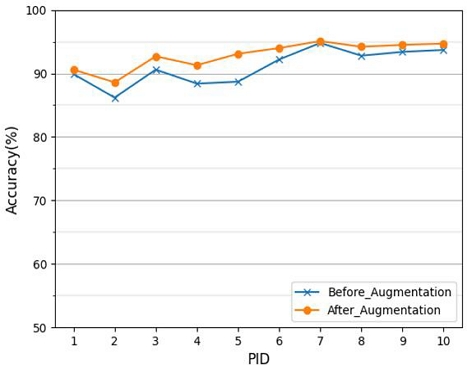
Comparison of accuracy
In terms of recall, precision, and F1-score, walking activities remained stable (0.946, 0.961, and 0.954, respectively), while running activities showed notable improvements, reaching 0.821, 0.847, and 0.834, respectively. Compared to pre-augmentation values, the F1-score for running increased by approximately 13% to 16%, indicating enhanced authentication under previously underrepresented activity conditions. These results suggest that data augmentation improved the model’s robustness by enriching data diversity, reducing overfitting, and enhancing generalization across heterogeneous activity contexts.
Ⅵ. Conclusion
This study examined authentication accuracy using gait data from real-world activities and demonstrated the effectiveness of data augmentation in improving model performance. Unlike previous research constrained to controlled environments, our approach leveraged naturalistic smartphone data to better reflect real-world variability. The model maintained high accuracy for walking activities but showed reduced performance during running, primarily due to data imbalance. By applying augmentation techniques, we improved the running authentication accuracy by up to 7%, underscoring the value of synthetic data in addressing underrepresented activity types.
Despite these contributions, limitations remain. The relatively small sample size may constrain statistical validity and generalizability, and the data processing pipeline lacks full automation. Future work may focus on expanding the dataset across broader real-world contexts and user profiles, as well as refining augmentation techniques to further enhance model robustness and scalability.
Acknowledgments
This study has been worked with the support of a research grant of Gangneung-Wonju National University in 2024
References
-
M. Abuhamad, T. Abuhmed, D. Mohaisen, and D. Nyang, "AUToSen: Deep-Learning-Based Implicit Continuous Authentication Using Smartphone Sensors", IEEE Internet of Things Journal, Vol. 7, pp. 5008-5020, Feb. 2020.
[https://doi.org/10.1109/JIOT.2020.2975779]

-
S. R. V. Sudhakar, N. Kayastha, and K. Sha, "ActID: An efficient framework for activity sensor based user identification", Computers & Security, Vol. 108, Sep. 2021.
[https://doi.org/10.1016/j.cose.2021.102319]
-
R. San-Segundo, J. D. Echeverry-Correa, C. Salamea-Palacios, S. L. Lutfi, and J. M. Pardo, "I-vector analysis for Gait-based Person Identification using smartphone inertial signals", Pervasive and Mobile Computing, Vol. 38, pp. 140-153, Jul. 2017.
[https://doi.org/10.1016/j.pmcj.2016.09.007]
-
S. Chung, C. Y. Jeong, J. M. Lim, J. L., K. J. Noh, G. Kim, H. Jeong. "Real-world multimodal lifelog dataset for human behavior study", ETRI Journal, Vol. 44, No. 3, pp. 426-437, Jun. 2022.
[https://doi.org/10.4218/etrij.2020-0446]
-
Y. Hutabarat, D. Owaki, and M. Hayashibe, "Recent Advances in Quantitative Gait Analysis Using Wearable Sensors: A Review", IEEE Sensors Journal, Vol. 21, pp. 26470-26487, Oct. 2021.
[https://doi.org/10.1109/JSEN.2021.3119658]
-
P. Connor and Arun Ross, "Biometric recognition by gait: A survey of modalities and features", Computer Vision and Image Understanding, Vol. 167, pp. 1-27, Feb. 2018.
[https://doi.org/10.1016/j.cviu.2018.01.007]
-
J. P. Singh, S. Jain, S. Arora, and U. P. Singh, "Vision-Based Gait Recognition: A Survey", IEEE Access, Vol. 6, pp. 70497-70527, Nov. 2018.
[https://doi.org/10.1109/ACCESS.2018.2879896]
-
P. Karampelas and T. Bourlai, "A Survey of Using Biometrics for Smart Visual Surveillance: Gait Recognition, in: Surveillance in Action", Advanced Sciences and Technologies for Security Applications, Springer, Nov. 2017.
[https://doi.org/10.1007/978-3-319-68533-5_1]
-
S. Sprager and M. B. Juric, "Inertial Sensor-Based Gait Recognition: A Review", Sensors (Basel), Vol. 15, No. 9, pp. 22089-127, Sep. 2015.
[https://doi.org/10.3390/s150922089]
-
R. Leyva, G. Santos, A. Rocha, V. Sanchez, and C. T. Li, "Accelerometer Dense Trajectories for Activity Recognition and People Identification", International Workshop on Biometrics and Forensics (IWBF), Vol. 7, pp. 1-6, Jun. 2019.
[https://doi.org/10.1109/IWBF.2019.8739218]
-
R. Delgado-Escaño, F. M. Castro, J. R. Cózar, M. J. Marín-Jiménez, and N. Guil, "An End-to-End Multi-Task and Fusion CNN for Inertial-Based Gait Recognition", IEEE Access, Vol. 7, pp. 1897-1908, Dec. 2019.
[https://doi.org/10.1109/ACCESS.2018.2886899]
-
L. Tran, T. Hoang, T. Nguyen, H. Kim, and D. Choi, "Multi-Model Long Short-Term Memory Network for Gait Recognition Using Window-Based Data Segment", IEEE Access, Vol. 9, pp. 23826-23839, Feb. 2021.
[https://doi.org/10.1109/ACCESS.2021.3056880]
-
F. Sun, C. Mao, X. Fan, and Y. Li, "Accelerometer-Based Speed-Adaptive Gait Authentication Method for Wearable IoT Devices", IEEE Internet of Things Journal, Vol. 6, pp. 820-830, Jul. 2018.
[https://doi.org/10.1109/JIOT.2018.2860592]
-
A. R. Kothamachu and B. Chakraborty, "Real Time Gait based Person Authentication using Deep Hybrid Network", IEEE International Conference on Knowledge Innovation and Invention (ICKII), Vol. 4, pp. 155-159, Jul. 2021.
[https://doi.org/10.1109/ICKII51822.2021.9574763]
-
M. Gadaleta and M. Rossi, "IDNet: Smartphone-based gait recognition with convolutional neural networks", Pattern Recognition, Vol. 74, pp. 25-37, Feb. 2018.
[https://doi.org/10.1016/j.patcog.2017.09.005]
-
N. Kala, T. Bhatia, and N. Aggarwal, "Person Identification and Characterization from Gait Using Smartphone", International Conference on Communication Systems & Networks (COMSNETS), Vol. 11, pp. 492-495, May 2019.
[https://doi.org/10.1109/COMSNETS.2019.8711131]
-
W. Xu, Y. Shen, C. Luo, J. Li, W. Li, anf A. Y. Zomaya, "Gait-Watch: A Gait-based context-aware authentication system for smart watch via sparse coding", Ad Hoc Networks, Vol. 107, Oct. 2020.
[https://doi.org/10.1016/j.adhoc.2020.102218]
-
G. Giorgi, A. Saracino, and F. Martinelli, "Using recurrent neural networks for continuous authentication through gait analysis", Pattern Recognition Letters, Vol. 147, pp. 157-163, Jul. 2021.
[https://doi.org/10.1016/j.patrec.2021.03.010]
-
M. Ehatisham-ul-Haq, M. A. Azam, U. Naeem, Y. Amin, and J. Loo, "Continuous authentication of smartphone users based on activity pattern recognition using passive mobile sensing", Journal of Network and Computer Applications, Vol. 109 pp. 24-35, May 2018.
[https://doi.org/10.1016/j.jnca.2018.02.020]
-
Y. Tsai and Y. Peter Hong, "Center-Assisted Personal Gait Authentication Using Orientation Adversarial Feature Extraction", International Workshop on Machine Learning for Signal Processing (MLSP), Vol. 29, pp. 1-6, Oct. 2019.
[https://doi.org/10.1109/MLSP.2019.8918789]
-
L. V. R. Asuncion, J. X. P. D. Mesa, P. K. H. Juan, N. T. Sayson, and A. R. D. Cruz, "Thigh Motion-Based Gait Analysis for Human Identification using Inertial Measurement Units (IMUs)", IEEE International Conference on Humanoid, Nanotechnology, Information Technology, Communication and Control, Environment and Management (HNICEM), Baguio City, Philippines, Vol. 10, pp. 1-6, Nov. 2018.
[https://doi.org/10.1109/HNICEM.2018.8666422]
-
J. Choi, S. Choi, and T. Kang, "Smartphone Authentication System Using Personal Gaits and a Deep Learning Model", Sensors, Vol. 23, No. 14, Jul. 2023.
[https://doi.org/10.3390/s23146395]

2023. 2 : BS degree, Dept. of Computer Science & Engineering, Gananeung-Wonju National University
Research interests: Artficial Intelligence

2000. 2 : BS degree, Dept. of Computer Science & Engineering, Gangneung-Wonju National University
2008. 8 : MS degree, Dept. of Computer Science, Iowa State University
2015. 5 : PhD degree, Dept. of Computer Science, University of Nebraska at Omaha
2015. 8 ~ 2016. 2 : Assistant Professor, Dept. of Computer Science, Swaziland Christian University
2016. 8 ~ 2019. 2 : Teaching Professor, Dept. of Software, Ajou University
2019. 3 ~ Present : Professor, Dept. of Computer Science & Engineering, Gangneung-Wonju National University
Research interests: Internet of Things, Machine Learning and Deep Learning, Gait Analysis

1985. 2 : BS degree, Dept. of Mathematics, Yonsei University
1988. 2 : BS degree, Dept. of Computer Science, Korea University
1991. 2 : MS degree, Dept. of Mathematics, Korea University
1996. 8 : PhD degree, Dept. of Computer Science, Korea University
1997. 3 ~ Present : Professor, Dept. of Computer Science & Engineering, Gangneung-Wonju National University
Research interests : Complex Systems, Artificial Life, Artificial Intelligence, Soft Computing