
Conflict-Aware ACO with ORCA-Inspired Local Avoidance for Multi-Robot Navigation
 ; Young Eun Song**
Abstract
In confined environments, deadlocks and collisions may occur when multiple robots pass through narrow corridors. This paper proposes a hybrid framework that combines conflict-aware Ant Colony Optimization (ACO), ORCA-inspired local collision avoidance, and a corridor coordination mechanism. Conflict-aware ACO is used to generate global path-point trajectories while considering both node and edge conflicts, and local velocity adjustments are applied during execution. A state-based corridor mechanism is introduced to resolve collision and deadlock issues. CoppeliaSim was used for qualitative validation, while MATLAB was used for quantitative evaluation. The study considered three robotic scenarios and evaluated each method through 30 independent runs in each scenario. In the “narrow corridor,” “intersection,” and “alternative route” scenarios, the proposed method achieved success rates of 80.0%, 100%, and 83.33%, respectively. The results indicate improved conflict-handling performance under the tested scenarios, although the additional coordination required in narrow corridors may increase completion time.
초록
본 논문에서는 다중 로봇의 충돌과 교착 상태를 줄이기 위해 충돌 인식 개미 군집 최적화(ACO), ORCA 착안형 국소 회피 및 상태 기반 복도 조정을 결합한 주행 프레임워크를 제안한다. 전역 계획에서는 노드·에지 충돌을 고려하고, 실행 중에는 속도와 복도 진입 순서를 조정한다. CoppeliaSim으로 정성적 검증을 수행하고 MATLAB으로 정량 평가하였다. 두 로봇을 대상으로 좁은 복도, 교차로 및 대체 경로 시나리오에서 각 방법을 30회씩 실행하였다. 제안 방법의 성공률은 각각 80.0%, 100%, 83.33%였다. 시험 조건에서 충돌 처리 성능이 개선되었으나, 좁은 복도에서는 추가적인 대기와 조정으로 완료시간이 증가하는 상충 관계가 나타났다.
Keywords:
ant colony optimization, multi-robot navigation, collision avoidance, ORCA, corridor coordinationⅠ. Introduction
With the rapid advancement of automation and intelligent logistics, multi-robot systems have been extensively deployed in applications such as warehouse automation, service robotics, and autonomous transportation. In these scenarios, multiple robots often share constrained environments, including narrow corridors, intersections, and merging paths. While individual path planning algorithms can generate efficient routes for single robots, the interaction among multiple robots introduces significant challenges, such as collisions, congestion, and deadlocks. Therefore, designing a path planning strategy that ensures both safety and efficiency in multi-robot systems has become an important research problem [1].
Existing rule-based priority methods are simple but fail to perform effectively in complex environments. Conflict-Based Search (CBS) can provide optimal solutions but suffers from high computational complexity in large-scale scenarios [2]. Reactive approaches such as ORCA-inspired local collision avoidance enable fast local collision avoidance but lack global coordination [3]-[5]. Extensions of reciprocal collision avoidance have also been developed for non-holonomic robots, variable-responsibility settings, and hybrid collision-avoidance and route-planning problems [6]-[8]. Reinforcement learning-based methods offer adaptability but often require extensive training and exhibit limited stability [9].
Ant Colony Optimization (ACO), a swarm intelligence-based metaheuristic, has shown strong performance in solving combinatorial optimization problems due to its distributed decision-making mechanism and pheromone-based indirect communication. These characteristics make ACO particularly suitable for multi-robot systems, where decentralized coordination is desirable. However, standard ACO does not explicitly consider collision avoidance in multi-agent environments, as it primarily focuses on optimizing individual path quality rather than joint execution feasibility [10]-[12].
To address these limitations, this paper proposes a hybrid global–local path planning framework that integrates conflict-aware ACO with ORCA-inspired local collision avoidance. In the proposed method, ACO is employed as a global planner to generate efficient paths with conflict-aware pheromone updates, while ORCA-inspired local avoidance is used as a local reactive controller to ensure real-time collision avoidance during execution.
By combining global conflict-aware planning with local avoidance and corridor coordination, the proposed framework is designed to improve conflict handling in constrained multi-robot environments.
The main contributions of this paper are summarized as follows:
- 1. A hybrid global–local path planning framework that integrates Ant Colony Optimization (ACO) with ORCA-inspired local collision avoidance for multi-robot systems.
- 2. A conflict-aware ACO strategy incorporating spatio-temporal node and edge conflict penalties.
- 3. A coordination mechanism supporting two-robot navigation in constrained environments.
- 4. CoppeliaSim-based implementation validation and MATLAB-based quantitative comparison in representative two-robot scenarios.
Ⅱ. Problem Formulation
In this study, the multi-robot path planning problem is formulated as a graph-based optimization problem in a shared environment. The environment is represented as a graph G=(V,E), where V denotes the set of nodes (positions in the environment), and E represents the set of edges connecting nodes [13]. Each edge is associated with a travel cost reflecting distance or traversal time. A set of robots R={r1,r2,...rn} operate in the environment. Each robot is assigned a start node and a goal node, and must find a path from its start to its destination. A path is defined as a sequence of nodes over discrete time steps [14][15].
In multi-robot settings, conflicts may occur when multiple robots attempt to occupy the same resource simultaneously. In this work, two types of conflicts are considered:
- 1. Node conflict, where two robots occupy the same node at the same time step.
- 2. Edge conflict, where two robots traverse the same edge in opposite directions at the same time.
The objective of the problem is to find a set of collision-free paths for all robots while minimizing the overall cost. This can be formulated as:
| (1) |
where cost(Pk) represents the travel cost of robot k. Nnode(P) and Nedge(P) represent the numbers of node and edge conflicts, respectively. The weights ωn and ωe are used for the two conflict types, and λ controls the overall conflict penalty.
Specifically, the optimization aims to reduce collision occurrences and deadlocks while maintaining reasonable path length and travel time, thereby balancing safety and efficiency in shared environments.
Ⅲ. Proposed Method
3.1 Global planning (ACO)
First, the environment is represented as a grid-based graph consisting of free cells, obstacle cells, and traversable edges. Each ant constructs a candidate path from the start node to the goal node by probabilistically selecting neighboring nodes according to pheromone intensity and heuristic information. After each iteration, the pheromone values are updated according to the quality of the generated paths.
ACO-based Path Planning: The core of this method lies in incorporating collision risks into the path planning process, rather than addressing them during the execution phase.
Standard ACO Formulation: In the standard ACO framework, artificial ants construct solutions by probabilistically selecting edges based on pheromone intensity and heuristic information. The probability of choosing an edge (i,j) is defined as:
| (2) |
where τij represents the pheromone value on edge (i,j), ηij denotes the heuristic desirability, and α, β control their relative importance. Ni denotes the set of feasible neighboring nodes of node i.
3.2 Conflict-aware path evaluation
To reduce path conflicts in global planning, the path of Robot A is first generated and used as a spatio-temporal reference when planning the path of Robot B. In the current two-robot implementation, the planning order is fixed. The planning order does not depend on the initial positions of the robots. However, different initial positions may affect the generated paths. Changing the planning order may affect the generated paths. For each movement, node and edge conflicts are evaluated at the corresponding discrete time steps. The conflict cost is defined as:
| (3) |
where Cnode=1 when two robots occupy the same node at the same time, and Cedge=1 when two robots traverse the same edge in opposite directions during the same time step.
The transition score used in the implemented ACO planner is modified as:
| (4) |
Therefore, candidate movements associated with higher conflict costs receive lower selection scores during path construction.

Main parameters of the conflict-aware ACO planner
The number of ACO iterations was fixed at 12 in the reported experiments. The effect of increasing the iteration count was not separately evaluated.
3.3 ORCA-inspired local collision avoidance
In open areas, a local collision avoidance method is used to reduce the risk of collision between robots. When another robot enters the predefined safety distance, the robot adjusts its preferred velocity away from the neighboring robot. The velocity correction is calculated as:
| (5) |
| (6) |
where d is the distance between two robots, drobot is the robot safety distance, and kavoid is the local avoidance gain. In the implementation, drobot=0.90 m and kavoid=0.20 m/s.
3.4 Hybrid global–local integration
ACO planning generates a global path for each robot consisting of a series of waypoints. As it moves, the robot proceeds toward its destination along these waypoints. In open areas, when other robots are nearby, local avoidance methods adjust the robot’s speed and direction. When a robot reaches a narrow corridor, the corridor coordination mechanism is activated. The robot will either enter the corridor or move to a buffer zone and wait. After passing through the corridor, it will continue along its original ACO path.
No online global re-planning is performed in the current implementation. After local avoidance or corridor waiting, the robot continues to follow the remaining ACO waypoints. When both robots approach the corridor simultaneously, the robot closer to its corridor entry is given priority, while the other robot moves to the buffer area and waits.
3.5 Corridor coordination strategy
The corridor control uses four states: FOLLOW, GOTO_BUFFER, WAIT, and PASS. In the FOLLOW state, the robot follows the ACO path. If the corridor is free, the robot enters the PASS state and moves through it. If another robot is already using the corridor, the robot moves to the buffer area and waits. When the corridor becomes free, the waiting robot enters the PASS state. After leaving the corridor, it returns to the FOLLOW state and continues toward its goal.
When both robots approach the corridor simultaneously, the robot closer to its corridor entry is given priority, while the other robot waits in the buffer area.
Ⅳ. Experimental Setup
CoppeliaSim was used for implementation validation and qualitative visualization of the two-robot navigation process. The simulated environment included narrow corridors, intersections, and obstacles, allowing corridor access, local avoidance, and waypoint following to be observed directly. The CoppeliaSim demonstrations were not used to generate the quantitative comparison reported in Tables 3 and 4.
Quantitative experiments were conducted in MATLAB using three representative two-robot scenarios: a head-on encounter in a narrow corridor, simultaneous entry into an intersection, and an alternative-route scenario. Four methods—Standard ACO, Local Avoidance Only, Standard ACO + Local Avoidance + Corridor Coordination, and the Proposed Method—were each evaluated over 30 independent runs per scenario. Success rate, collision events, deadlock events, completion time, and path length were recorded. Average completion time and path length were calculated only for successful runs.
The methods with local avoidance use the same local avoidance function and parameters. Standard ACO + Local + Corridor and the Proposed Method also use the same corridor coordination mechanism when it is enabled. In the Alternative Route scenario, a central obstacle allows robots to take either an upper or a lower route. Corridor coordination is disabled in this scenario.
Ⅴ. Results and Analysis
The proposed method was evaluated using collision count, deadlock count, travel time, path length, and success rate, which reflect both safety and efficiency in multi-robot navigation. For comparison, four methods were considered: Standard ACO, Local Avoidance Only, Standard ACO + Local Avoidance + Corridor Coordination, and the Proposed Method. The comparison focused on their ability to handle conflicts in constrained two-robot environments.
Fig. 1 illustrates a representative CoppeliaSim conflict scenario used for qualitative validation. In Fig. 1(a), two robots approach a constrained region and may encounter a conflict. In Fig. 1(b), the local avoidance and corridor coordination mechanisms modify robot motion to reduce the immediate conflict.
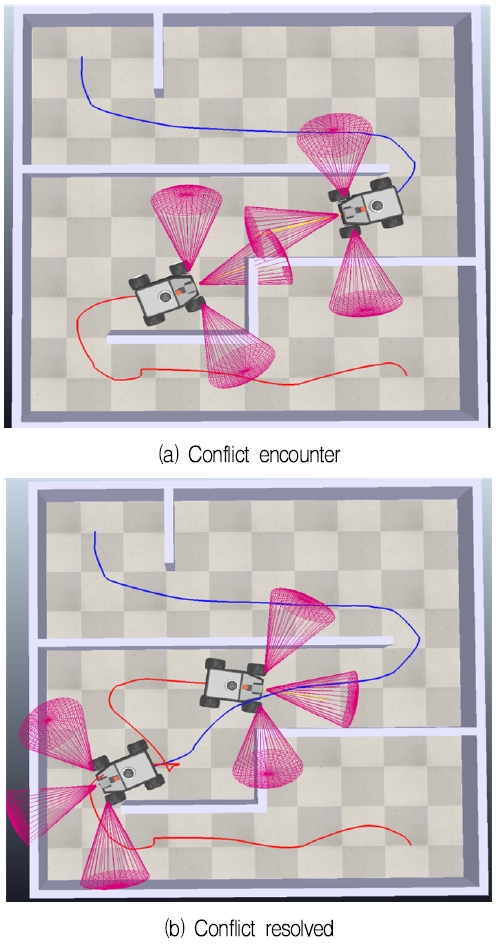
Robot navigation and conflict resolution in CoppeliaSim.
Table 2 summarizes the main controller parameters used in the CoppeliaSim experiments. The maximum linear and angular velocities were set to 0.38 m/s and 2.2 rad/s, respectively. The waypoint reaching threshold was 0.38 m. The robot safety distance and obstacle safety distance were set to 0.90 m and 0.12 m, respectively. The corridor detection radius was 1.25 m, the buffer offset distance was 0.60 m, and the local avoidance gain was 0.20 m/s. These parameters remained fixed during the CoppeliaSim experiment
Main parameters used in the CoppeliaSim simulation
Tables 3 and 4 present the scenario-wise quantitative comparison of the four navigation methods. In the Narrow Corridor scenario, the Proposed Method achieved an 80.0% success rate, while Standard ACO + Local Avoidance + Corridor Coordination achieved 83.33%. Their collision and deadlock counts were also similar, indicating that corridor coordination was the dominant factor in this scenario.
Comparison of success rates and conflict events (30 runs per method).
Scenario-wise comparison of completion time and path length
Although the success rate in the “narrow corridor” was only 13.33% and 0% at “intersections,” these results indicate that global path planning alone cannot handle obstacle avoidance for robots in narrow passages, as completion time and path length are calculated only for successful runs. Therefore, the standard ACO achieved only four successful trials in the “narrow corridor” environment. Its shorter completion time does not necessarily indicate superior overall performance. The proposed framework improves conflict resolution capabilities by combining global planning, local avoidance, and corridor coordination.
In the Intersection scenario, both the Proposed Method and Standard ACO + Local Avoidance + Corridor Coordination achieved a 100% success rate with no collision or deadlock events, indicating that the coordination mechanism was sufficient to resolve the tested intersection conflicts.
In the Alternative Route scenario, the Proposed Method achieved an 83.33% success rate, compared with 46.67% for Standard ACO, Local Avoidance Only, and Standard ACO + Local Avoidance + Corridor Coordination. The Proposed Method also reduced collision and deadlock events from 16 to 5, demonstrating the additional contribution of Conflict-Aware ACO when alternative global routes were available.
In the “Alternative Route” scenario, the corridor coordination function is disabled. Therefore, “Local Avoidance Only” and “Standard ACO + Local + Corridor” use the same control settings and produce exactly the same results. The standard ACO also achieved 14 successful runs, although the completion times and path lengths of some failed runs differed. Since the averages are calculated based solely on successful runs, the averages for these three methods are exactly the same.
Although the Proposed Method improved conflict-handling performance, it did not consistently reduce completion time or path length. In the Narrow Corridor scenario, the additional waiting and coordination increased completion time and path length, indicating a trade-off between safety and efficiency.
Ⅵ. Discussion
The experimental results show that the contribution of each component depends on the navigation scenario. In the Narrow Corridor scenario, Standard ACO + Local Avoidance + Corridor Coordination achieved an 83.33% success rate, which was comparable to the 80.0% achieved by the Proposed Method. In the Intersection scenario, both methods achieved a 100% success rate with no collision or deadlock events. These results indicate that corridor coordination is the dominant factor in structurally constrained passages. In contrast, in the Alternative Route scenario, the Proposed Method increased the success rate from 46.67% to 83.33% and reduced collision and deadlock events from 16 to 5, showing that Conflict-Aware ACO provides an additional benefit when alternative global routes are available. However, the Proposed Method did not consistently reduce completion time or path length. In the Narrow Corridor scenario, the additional waiting and coordination increased both completion time and path length, indicating a trade-off between safety and efficiency. The current experiments were limited to two robots and three simulation scenarios. Future work will include larger-scale multi-robot experiments and validation using real robots.
Ⅶ. Conclusion
This paper presented a hybrid multi-robot navigation framework combining Conflict-Aware ACO, ORCA-inspired local avoidance, and corridor coordination. The Proposed Method achieved success rates of 80.0%, 100%, and 83.33% in the Narrow Corridor, Intersection, and Alternative Route scenarios, respectively. The additional control experiment showed that corridor coordination was the dominant factor in the Narrow Corridor and Intersection scenarios, whereas Conflict-Aware ACO provided a clear additional benefit in the Alternative Route scenario. Although the proposed framework improved conflict-handling performance, additional coordination increased completion time and path length in narrow corridors, indicating a safety–efficiency trade-off. Future work will extend the proposed framework to scenarios involving three or more robots. To prevent deadlocks caused by fixed priority assignments, priority will be adjusted based on waiting times and the operational status of channels. Next, deadlock and recovery mechanisms should be considered, including temporary waiting, buffer backtracking, and other path re-planning issues. Through further experiments, the framework’s scalability and robustness for multi-robot systems in more complex environments will be evaluated.
Acknowledgments
This work was supported by the Korea government (MSIT) through the COMPA under Grant RS-2025-02315174-2027, and by MOTIE, Korea, through the Technology Innovation Program under Grant RS-2024-00433599.
References
-
L. E. Parker, "Current State of the Art in Distributed Autonomous Mobile Robotics", Distributed Autonomous Robotic Systems 4, Springer, pp. 3-12, Oct. 2000.
[https://doi.org/10.1007/978-4-431-67919-6_1]

-
G. Sharon, R. Stern, A. Felner, and N. R. Sturtevant, "Conflict-based search for optimal multi-agent path finding", Artificial Intelligence, Vol. 219, pp. 40-66, Feb. 2015.
[https://doi.org/10.1016/j.artint.2014.11.006]
-
J. van den Berg, S. J. Guy, M. Lin, and D. Manocha, "Reciprocal n-body collision avoidance", Robotics Research: The 14th International Symposium ISRR, Springer Tracts in Advanced Robotics, Vol. 70, pp. 3-19, May 2011.
[https://doi.org/10.1007/978-3-642-19457-3_1]
-
J. Alonso-Mora, A. Breitenmoser, P. Beardsley, and R. Siegwart, "Reciprocal collision avoidance for multiple car-like robots", Proc. IEEE International Conference on Robotics and Automation (ICRA), Saint Paul, MN, USA, pp. 360-366, May 2012.
[https://doi.org/10.1109/ICRA.2012.6225166]
-
J. van den Berg, M. Lin, and D. Manocha, "Reciprocal velocity obstacles for real-time multi-agent navigation", Proc. IEEE International Conference on Robotics and Automation (ICRA), Pasadena, CA, USA, pp. 1928-1935, May 2008.
[https://doi.org/10.1109/ROBOT.2008.4543489]
-
J. Alonso-Mora, A. Breitenmoser, M. Rufli, P. Beardsley, and R. Siegwart, "Optimal reciprocal collision avoidance for multiple non-holonomic robots", Distributed Autonomous Robotic Systems: The 10th International Symposium, Springer Tracts in Advanced Robotics, Vol. 83, pp. 203-216, Sep. 2012.
[https://doi.org/10.1007/978-3-642-32723-0_15]
-
K. Guo, D. Wang, T. Fan, and J. Pan, "VR-ORCA: Variable Responsibility Optimal Reciprocal Collision Avoidance", IEEE Robotics and Automation Letters, Vol. 6, No. 3, pp. 4520-4527, Jul. 2021.
[https://doi.org/10.1109/LRA.2021.3067851]
- T. Chauvin, D. Gianazza, and N. Durand, "ORCA-A*: A Hybrid Reciprocal Collision Avoidance and Route Planning Algorithm for UAS in Dense Urban Areas", Proc. SESAR Innovation Days, Rome, Italy, pp. 2024-059, Nov. 2024. https://www.sesarju.eu/sites/default/files/documents/sid/2024/papers/SIDs_2024_paper_059%20final.pdf, .
-
S. J. Guy, J. Chhugani, C. Kim, N. Satish, M. C. Lin, D. Manocha, and P. Dubey, "ClearPath: Highly Parallel Collision Avoidance for Multi-Agent Simulation", Proc. ACM SIGGRAPH/Eurographics Symposium on Computer Animation, New Orleans, Louisiana, USA, pp. 177-187, Aug. 2009.
[https://doi.org/10.1145/1599470.1599494]
-
M. Dorigo, V. Maniezzo, and A. Colorni, "Ant system: Optimization by a colony of cooperating agents", IEEE Transactions on Systems, Man, and Cybernetics, Part B, Vol. 26, No. 1, pp. 29-41, Feb. 1996.
[https://doi.org/10.1109/3477.484436]
-
M. Dorigo and L. M. Gambardella, "Ant colony system: A cooperative learning approach to the traveling salesman problem", IEEE Transactions on Evolutionary Computation, Vol. 1, No. 1, pp. 53-66, Apr. 1997.
[https://doi.org/10.1109/4235.585892]
-
M. Dorigo, M. Birattari, and T. Stützle, "Ant colony optimization", IEEE Computational Intelligence Magazine, Vol. 1, No. 4, pp. 28-39, Nov. 2006.
[https://doi.org/10.1109/MCI.2006.329691]
-
S. M. LaValle, "Planning Algorithms", Cambridge University Press, May 2006.
[https://doi.org/10.1017/CBO9780511546877]
-
R. Stern, N. R. Sturtevant, A. Felner, S. Koenig, H. Ma, T. T. Walker, J. Li, D. Atzmon, L. Cohen, T. K. S. Kumar, R. Barták, and E. Boyarski, "Multi-agent pathfinding: Definitions, variants, and benchmarks", Proceedings of the International Symposium on Combinatorial Search, Napa, California, USA, Vol. 10, No. 1, pp. 151-158, Jul. 2019.
[https://doi.org/10.1609/socs.v10i1.18510]
-
R. Stern, "Multi-Agent Path Finding - An Overview", Artificial Intelligence: 5th RAAI Summer School, Dolgoprudny, Russia, Vol. 11866, pp. 96-115, Jul. 2019.
[https://doi.org/10.1007/978-3-030-33274-7_6]

2024. 8 : B.S. degree, Dept. of Electro-Mechanical Systems Engineering, Korea University, Sejong Campus
2025. 3 ~ present: M.S. candidate, Dept. of Mobility Science and Engineering, Korea University
Research interests : Multi-Robot Navigation, Path Planning, Collision Avoidance, Model Predictive Control, and World Models.

2013. 3 : Ph.D. degree, Dept. of Electrical Engineering and Information Systems, The University of Tokyo
2013. 5 ~ 2017. 1 : Senior Researcher, Samsung Heavy Industries
2017. 3 ~ 2022. 8 : Associate Professor, Dept. of Electrical Engineering, Hoseo University
2020. 10 ~ present : CEO, FieldRo
2022. 9 ~ present : Associate Professor, Dept. of Mobility Science and Engineering, Korea University
Research interests : Field Robotics, Autonomous robotics, sensor fusion AI and robot learning.