
Closed-Form Expression of Probability of Strictly Positive Secrecy Capacity over UAV-to-Ground Channels with Shadowing

Abstract
In this paper, we investigate the Physical Layer Security (PLS) of UAV-to-ground communications under realistic shadowed fading channels. In contrast to the existing complex integral-form expressions for the probability of Strictly Positive Secrecy Capacity (SPSC), which is an essential performance metric, we derive novel exact closed-form expressions for the probability of SPSC in both Double-Shadowing (DS) and Single-Shadowing (SS) scenarios by judiciously exploiting the Meijer G-function. By obviating the need for computationally intensive numerical integrals, the proposed closed-form formulas significantly facilitate security performance evaluation.
초록
본 논문에서는 섀도우잉 효과가 동반된 무인기(UAV, Unmanned Aerial Vehicle)와 지상 간 페이딩 채널 환경에서의 물리계층 보안(PLS) 성능을 분석하였다. 핵심 성능 지표인 엄격한 양의 보안 용량(SPSC, Strictly Positive Secrecy Capacity) 확률과 관련하여 기존의 복잡한 적분식 기반 분석을 개선하기 위해, Meijer G-함수를 활용하여 이중 섀도우잉(DS, Double-Shadowing) 및 단일 섀도우잉(SS, Single-Shadowing) 시나리오 모두에서 SPSC 확률에 대한 정확한 닫힌 형태의 수식을 새롭게 유도하였다. 복잡한 수치 적분의 필요성을 배제함으로써, 제안된 닫힌 형태의 수식들이 보안 성능 평가의 연산 효율을 크게 향상시킴을 확인하였다.
Keywords:
unmanned aerial vehicles, UAVs, UAV-to-ground channels with shadowing, physical layer security, PLS, probability of strictly positive secrecy capacityⅠ. Introduction
Unmanned aerial vehicles (UAVs) are becoming a critical component of beyond 5G (B5G) and 6G cellular networks, offering flexible deployment, ubiquitous connectivity, and rapid recovery of network services. However, due to their high mobility and operational environments, UAV-to-ground links frequently experience Line-of-Sight (LoS) blockages and highly dynamic propagation conditions. Therefore, realistic channel models must account for both multipath fading and large-scale shadowing simultaneously. Recently proposed composite fading models, which incorporate the Nakagami-m distribution for multipath and the inverse-gamma distribution for shadowing, effectively capture these impairments in both Double-Shadowing (DS) and Single-Shadowing (SS) UAV-to-ground communication scenarios [1][2].
Due to the inherent openness of wireless channels, ensuring secure data transmissions is essential. Physical Layer Security (PLS) has emerged as a robust paradigm to prevent eavesdropping without relying on complex resource-heavy cryptographic methods [3]. Key PLS performance metrics include Average Secrecy Capacity (ASC), Secrecy Outage Probability (SOP), and the probability of Strictly Positive Secrecy Capacity (SPSC). Although recent study in [4] investigated these metrics, it presented the expression of the probability of SPSC exclusively in an integral form. This mathematical limitation impedes efficient system design and analysis. To overcome this, we derive exact closed-form expressions for the probability of SPSC, which significantly expedites security performance evaluation, thereby demonstrating the practical value of the proposed analytical framework.
Ⅱ. UAV-to-Ground Channel Models
In this section, we consider a UAV-to-ground communication system comprising a legitimate receiver (Bob) and an eavesdropper (Eve), as depicted in Fig. 1.
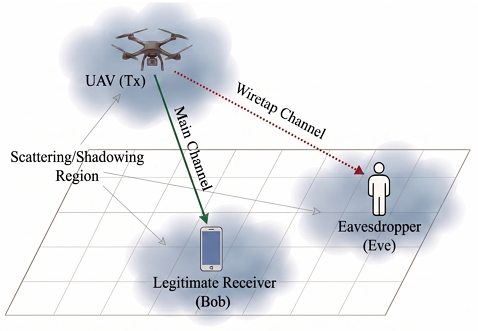
System model for UAV-to-ground channels
For more detailed information on the system structure and channel modeling, refer to [1][2]. To provide a unified and effective representation, we use the subscript index k∈{B,E} to denote the respective channels for Bob and Eve.
In the DS scenario, the signals experience shadowing in the scattering regions around both the transmitter and the receiver. The scaling constant for this scenario is given by [1][2]
| (1) |
where m1,k and m2,k denote the multipath fading parameters, and α1,k and α2,k represent the shadowing severity parameters. Then, the Probability Density Function (PDF) and the Cumulative Distribution Function (CDF) for the received Signal-to-Noise Ratio (SNR) γk are expressed with (1) as [1][2]
| (2) |
| (3) |
where denotes the Meijer G-function [5], and is the average SNR.
In the SS scenario in [1][2], shadowing is present in only one of the scattering regions. Then, the scaling constant is simplified to
| (4) |
and the PDF and CDF are given with (4) as [1][2]
| (5) |
| (6) |
Ⅲ. Probability of SPSC
The probability of SPSC is a fundamental metric that guarantees that the secure link can support a strictly positive transmission rate. To formulate this, the instantaneous secrecy capacity Cs(γB,γE) is fundamentally defined as [3][4]
| (7) |
The condition for a SPSC (i.e., Cs(γB,γE) > 0 from (7)) simplifies to the requirement that Bob's channel quality must be strictly superior to Eve's one (i.e, γB > γE). Thus, based on the foundational formulation in [4] and combining the definitions in (2), (3), (5), and (6), the probability of SPSC (i.e., PSPSC) can be formally defined and expanded into its integral form as [3][4]
| (8) |
Evaluating the integral in (8) directly is mathematically challenging, because it involves the product of two complex Meijer G-functions. To overcome this analytical bottleneck and avoid relying on time-consuming numerical integrations, we exploit a fundamental product integration identity of Meijer G-functions provided in [5, Eq. (07.34.21.0011.01)]. This pivotal identity serves as a key mathematical tool, enabling the exact evaluation of infinite integrals involving the product of two Meijer G-functions. By carefully mapping the parameters of Bob's CDF and Eve's PDF into this identity framework, we can systematically resolve the integral into a single highly computable Meijer G-function for both scenarios.
By substituting the CDF of Bob's channel from (3) and the PDF of Eve's channel from (2) into the integral formulation in (8), and applying the aforementioned integration identity from [5, Eq. (07.34.21.0011.01)], we obtain the exact closed-form PSPSC for the DS scenario as
| (9) |
Similarly, by substituting the SS channel formulas (5) and (6) into the integral (8), and applying the same mathematical identity as given in [5, Eq. (07.34.21.0011.01)], the formula readily reduces to the following efficient closed-form representation as
| (10) |
Instead of computationally intensive numerical integrals, these closed-form formulas (9) and (10) can significantly facilitate security performance evaluation, where the Meijer G-function is a built-in function in most of the well-known mathematical software packages (e.g., MATLAB, MATHEMATICA, etc.).
Ⅳ. Numerical Results
In this section, we validate the derived closed-form expressions for PSPSC via Monte-Carlo simulations. Fig. 2 plots PSPSC versus the average SNR ratio (dB) as in [3]. Eve's parameters are fixed at m1,E = m2,E = 2.1 and α1,E = α2,E = 2.3. Bob's channel is simulated under severe (m1,B = m2,B = 3.2, α1,B = α2,B = 2.6) and mild (m1,B = m2,B = 3.2, αB = 3.7) conditions for both DS and SS scenarios.
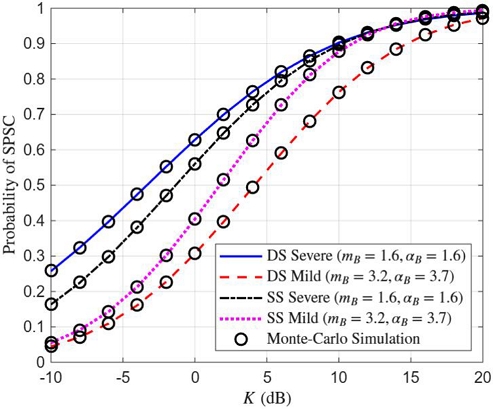
Probability of SPSC vs. K (dB) for double and single shadowing scenarios
As shown in Fig. 2, it is obvious that the exact analytical curves from (9) and (10) perfectly match the Monte-Carlo simulation results for various fading conditions, explicitly verifying our derivations. We can also observe that in the low-to-medium K regime (K ≤ 15dB), severe fading and shadowing yield a higher PSPSC compared to mild conditions. This is because the higher channel variance inherent in severe conditions provides more opportunistic moments where Bob's instantaneous SNR dramatically surpasses Eve's instantaneous SNR, despite lacking a significant average SNR advantage. By the same rationale, the DS scenario (higher variance) outperforms SS under severe conditions in this regime, whereas SS is preferable under mild conditions, where a stable channel is advantageous. In addition, to verify the computational efficiency, execution times are measured by exploiting MATLAB's 'timeit' function. For the severe fading scenario with K = 5 dB, evaluating the proposed closed-form formulas in (9) and (10) is approximately 317.2 and 1511.7 times faster for the DS and SS scenarios, respectively, than computing the numerical integration in (8).
V. Conclusion
In this paper, we have investigated the PLS of UAV-to-ground networks under shadowing effects. We have derived novel exact closed-form expressions for the probability of SPSC under both DS and SS scenarios by efficiently applying the Meijer G-function. Obviating the need for computationally demanding numerical integrations, these analytical solutions have remarkably improved the efficiency of security performance assessment. Furthermore, extensive Monte-Carlo simulations under various composite fading conditions have been conducted, demonstrating an excellent agreement with the derived closed-form expressions and comprehensively confirming the accuracy of the proposed analytical frameworks.
Acknowledgments
This research is financially supported by Hansung University.
References
-
P. S. Bithas, V. Nikolaidis, A. G. Kanatas, and G. K. Karagiannidis, "UAV-to-ground communications: channel modeling and UAV selection", IEEE Trans. Commun., Vol. 68, No. 8, pp. 5135-5144, Aug. 2020.
[https://doi.org/10.1109/TCOMM.2020.2992040]

-
R. Polus and C. D'Amours, "On the performance of MRC receivers in UAV-to-ground channels with shadowing", IEEE Wireless Commun. Lett., Vol. 12, No. 7, pp. 1249-1253, Jul. 2023.
[https://doi.org/10.1109/LWC.2023.3270122]
-
H. Lei, C. Gao, Y. Guo, and G. Pan, "On physical layer security over generalized gamma fading channels", IEEE Commun. Lett., Vol. 19, No. 7, pp. 1257-1260, Jul. 2015.
[https://doi.org/10.1109/LCOMM.2015.2426171]
-
R. Polus, C. D'Amours, and B. Kantarci, "Physical layer security over UAV-to-ground channels with shadowing", 2023 IEEE 97th Vehicular Technology Conference (VTC2023-Spring), Florence, Italy, pp. 1-5, Jun. 2023.
[https://doi.org/10.1109/VTC2023-Spring57618.2023.10199179]
- The Wolfram functions site, http://functions.wolfram.com, . [accessed: Jun. 10, 2026]