
사용자 중심 IoT 기반 반려견 놀이 제품 및 브랜드 ‘PEMBER’ 시스템 개발

초록
최근 펫 휴머니제이션(Pet Humanization)의 확산으로 반려견을 가족 구성원으로 인식하는 경향이 높아지고 있다. 하지만 맞벌이 가구가 증가하면서 보호자의 부재 시간이 늘어나 반려견의 분리불안이나 지루함과 같은 문제 행동이 사회적 이슈로 대두되고 있다. 본 연구는 보호자 부재 시에도 반려견의 정서적 안정과 자율적인 놀이 활동 지원을 위해 사용자 중심 디자인(UCD)을 기반으로 IoT 기반 반려견 놀이 브랜드 'PEMBER'를 개발하였다. 사용자 인터뷰(FGI)를 통해 도출된 요구사항을 반영하여 세 가지 주요 놀이 시나리오를 구성한 프로토타입을 제작하고 실제 사용자 환경에서 테스트하였다. 실험 결과 프로토타입은 반복 훈련을 통해 반려견의 놀이 참여와 자율적 행동을 촉진하고, 원격 조작과 자동 보상 시스템의 효과성을 입증하였다. 본 연구는 사용자 중심적 접근을 통해 보호자 부재 중 반려견의 긍정적인 행동 변화를 유도할 수 있는 가능성을 제시하였다.
Abstract
With the recent expansion of pet humanization, pets are increasingly considered as family members. However, due to the rising number of dual-income households, dogs often spend extended periods alone, resulting in behavioral issues such as separation anxiety and boredom. This study aims to develop an IoT-based dog play brand, 'PEMBER', employing a User-Centered Design (UCD) approach to support emotional stability and autonomous play for dogs during owner absences. Based on user interviews (FGI), three key play scenarios were identified: designated location response, sound signal response, and touch-based reward interaction. A prototype incorporating these scenarios was developed and tested in realistic user environments. Test results demonstrated that repeated training significantly improved dogs' autonomous engagement and behavior, validating the effectiveness of remote control and automated reward systems. Thus, this study highlights the potential of user-centered approaches to facilitate positive behavioral outcomes in dogs during owner absences.
Keywords:
IoT-based products, dog play, user-centered design, autonomous interaction, pet-tech, behavioral engagementⅠ. 서 론
현대 사회에서 반려동물은 단순한 애완동물을 넘어 가족 구성원으로 인식되며, 이에 따라 반려동물의 삶의 질에 대한 사회적 관심도 급증하고 있다. 하지만 1인 가구와 맞벌이 가구의 증가로 인해 보호자가 장시간 자리를 비우는 경우가 많아졌고, 이는 반려견의 분리불안, 파괴 행동, 우울증 등 다양한 문제행동을 유발하는 주요 원인이 되고 있다[1][2]. 국내 조사에 따르면 전체 가구의 약 25.7%가 반려동물을 키우고 있으며, 특히 직장인 보호자들이 반려견의 정서적 안정을 위한 대안이 있어야 하는 것으로 나타났다[3].
이러한 사회적 배경과 함께, 보호자의 개입 없이도 반려견 스스로 놀이를 통해 정서적·신체적 안정을 유지할 수 있는 자율적인 콘텐츠의 필요성이 대두되고 있다. 그러나 현재 시중에 출시된 대부분의 IoT(Internet of Things) 기반 반려견 놀이 제품은 보호자의 직접적인 상호작용이나 원격 제어에 의존하고 있어, 보호자 부재 시 반려견의 자발적인 놀이 참여를 유도하기에는 한계가 있다.
따라서 본 연구는 보호자 부재 상황에서도 반려견이 자발적으로 놀이에 참여할 수 있는 IoT 기반 놀이 콘텐츠의 가능성을 탐색하고, 이를 기반으로 한 제품 및 브랜드 개발의 방향성을 제시하고자 한다. 특히 사용자 중심 디자인(UCD, User-Centered Design) 방법론을 통해 보호자의 실질적 요구를 반영하고, 실사용 환경에서의 반응을 중심으로 프로토타입을 평가하여 콘텐츠의 유효성과 제품 가능성을 검토하였다. 본 연구는 놀이 콘텐츠의 자율성과 확장성을 중심으로 반려견의 정서적 안정 및 문제 행동 예방이라는 실질적인 효과를 기대하며, 보호자의 양육 부담을 완화하고 반려견의 삶의 질을 향상하는 실용적인 시스템 솔루션을 제안하고자 한다.
Ⅱ. 이론적 배경
펫 휴머니제이션(Pet Humanization)은 반려동물을 가족 구성원으로써 여기는 현상이다[4]. 즉 반려동물을 자녀처럼 양육하는 것이다[5][6]. 이는 1인 가구 증가, 맞벌이 가구 확대, 저출산 등 사회구조의 변화로 인해 더욱 두드러지고 있다[3].
보호자의 부재 시간이 증가함에 따라 반려견의 정서적 안정과 문제 행동 예방에 관한 관심이 높아짐에 따라 놀이 활동이 그 대안으로 받아들여지고 있다[7]. 반려견의 스트레스 및 불안 감소, 인지적 발달 촉진, 사회성 강화 등 정서적·신체적 건강 유지에 필수적이며[2][8][9], 코르티솔(cortisol) 수치를 낮추고 옥시토신(Oxytocin) 분비를 증가시켜 정서적 안정감을 높이는 효과가 입증되었다[10]-[12].
최근 IoT, AI 등의 첨단 기술이 적용된 펫테크(Pet-Tech) 산업이 빠르게 성장하고 있다. 펫테크 제품은 보호자 부재 시에도 반려견의 행동과 상태를 실시간으로 관리하고 원격 상호작용을 가능하게 한다[13][14]. 더 나아가 AI를 활용한 행동 분석과 맞춤형 피드백을 제공하여 반려견의 건강과 복지를 향상 시키고 보호자의 심리적 부담을 덜어주는 스마트한 기능이 강조되고 있다[15][16].
이러한 기술적 진보와 함께 사용자 중심 디자인의 중요성이 강조된다. 사용자 중심 디자인은 제품 개발 과정에서 사용자의 요구와 경험을 중심으로 설계부터 반복적 평가를 거쳐 제품의 사용성(Usability)과 사용자 경험(User experience)을 극대화하는 디자인 방법론이다[17]-[19].
Ⅲ. 연구 방법
3.1 연구 설계
본 연구는 사용자 중심(UCD) 접근법을 기반으로 반려견의 행동 문제를 완화하고 보호자의 부재 시에도 자율적 놀이가 가능한 IoT 기반 제품을 개발하기 위한 일련의 단계로 구성되었다. 연구 설계는 총 다섯 단계로 진행되었으며, 각 단계는 사용자 요구의 심층 이해와 그에 따른 실질적 시스템 도출을 목표로 하였다. 제품 연구의 전체적인 과정을 표 1에 정리하였다.

Design process for user-centered IoT-based dog play product development
첫째, 선행 연구 단계에서는 반려견의 문제 행동 유형과 원인을 문헌을 통해 분석하고, 기존 제품 및 IoT 기술 사례를 조사하여 기능적 요소를 표 2로 정리였다.
Analysis of problematic behavior types
둘째, 포커스 그룹 인터뷰를 통해 보호자 3인의 반려 경험과 니즈를 수집하고, 행동 특성 및 기존 제품의 한계를 파악하였다. 셋째, 인터뷰 데이터를 바탕으로 주요 놀이 유형과 요구사항을 도출하고, 사용자 중심 설계 인사이트를 구조화하였다. 넷째, 이를 기반으로 제작한 프로토타입을 활용해 3일간 사용자 환경 테스트를 실시하였으며, 반려견의 행동 반응과 놀이 지속성 등을 평가하였다. 마지막으로, 실험 결과를 정량·정성적으로 분석해 실질적인 디자인 방향을 도출하였고, 이는 향후 자율성, 상호작용성, 보상 시스템, 내구성, 사용자 편의성 측면에서 제품 개발 가이드라인으로 활용될 수 있다.
3.2 선행 연구
반려견의 행동 문제를 해결하기 위한 효과적인 방법 중 하나로 놀이 활동이 주목받고 있다. 기존 연구에 따르면 반려견의 문제 행동은 크게 네 가지 유형으로 분류되며, 그 원인 다수는 보호자 부재 시 발생하는 불안과 스트레스, 운동 부족 및 자극 결핍과 밀접한 관련이 있다[1][2]. 대표적인 문제 행동으로는 분리불안, 공격적 행동, 파괴 행동, 과잉 행동이 있으며, 이는 반려견의 정서적 불안정성과 관련된 행동 이상으로 해석된다[3].
이러한 문제 해결을 위한 수단으로 놀이 제품의 정서적, 인지적, 신체적 효과에 주목한 연구들이 진행되었다. 놀이 활동은 반려견의 스트레스 해소, 인지 자극, 사회적 유대 강화에 유의미한 영향을 미치며, 특히 보호자 부재 상황에서 반려견의 문제 행동 예방에 긍정적인 작용을 한다[9][20]. S. Duranton and A. Horowitz[21]는 후각 기반 놀이가 반려견의 긴장 완화와 안정된 행동 유도에 효과적이라고 보고하였으며, N. W. Milgram et al.[22]은 인지 자극 중심의 놀이가 노령견의 뇌 기능 유지에도 도움이 된다고 밝혔다.
아래 표 3은 반려견 장난감의 놀이 효과 분류 및 기대 효과를 분류한 자료이다. 현재 시중의 반려견 놀이 제품은 기능과 효과에 따라 다섯 가지 유형으로 분류할 수 있다. (1) 후각 놀이는 간식 찾기와 같은 후각 자극을 통해 스트레스 해소와 정서적 안정을 돕는다. (2) 탐색 놀이는 사냥 본능을 자극하여 지루함 해소와 문제행동 예방에 효과적이다. (3) 인지 자극 놀이는 퍼즐이나 게임 장치를 통해 두뇌 활동을 유도하며, 집중력 향상과 정서적 안정에 기여한다. (4) 신체 활동 놀이는 에너지 소비와 규칙적인 운동을 통해 건강 증진에 효과적이다. (5) 원격 상호작용 놀이는 보호자가 실시간으로 반려견과 소통하거나 보상을 줄 수 있도록 설계된 IoT 기반 장치로, 보호자의 부재 시에도 정서적 안정과 지속적인 놀이 참여를 가능하게 한다.
Classification of dog toys and expected effects of dog toys on play behavior
3.3 포커스 그룹 인터뷰(FGI)
본 연구에서는 놀이 콘텐츠 개발을 위해 2년 이상 반려견 양육 경험이 있고 업무상 장시간 집을 비우는 20~40대 보호자 3명을 대상으로 인터뷰를 수행하였다. 다양한 직업과 가족 환경을 가진 참가자들로부터 현실적이고 실질적인 의견을 수집하였다. 인터뷰 참여자 프로필은 아래 표 4와 같다.
Interview participant profiles
인터뷰는 표 5의 내용을 바탕으로 약 1시간 동안 진행되었다. 표 6의 내용과 같이 참가자들은 공통적으로 보호자 부재 시 반려견이 지루함과 불안감을 느끼고, 기존의 장난감에 쉽게 싫증을 내어 지속적인 상호작용이 어렵다고 응답하였다. 직장 생활로 인해 장시간 돌봄이 어렵고, 문제 행동 관리에 어려움이 있음을 밝혔다. 또한 기존 제품들이 자발적이고 다양한 놀이 콘텐츠를 제공하지 못하는 한계를 지적하며, 보호자가 없어도 반려견 스스로 흥미를 유지하고 능동적으로 참여할 수 있는 놀이 콘텐츠 개발의 필요성을 강조하였다.
Interview questions for focus group interview
Summary of interview results and content requirements
3.4 요구사항 및 핵심 인사이트 분석
인터뷰를 통해 보호자들이 원하는 놀이 방식을 분석한 결과, 선행 연구에서 제시된 후각 놀이, 탐색 놀이, 인지 자극 놀이, 신체 활동 놀이, 원격 상호작용 놀이의 핵심 요소를 포함한 세 가지 놀이 유형이 도출되었다. 첫째, 특정 장소에서 일정 시간 기다리면 보상을 제공하는 '기다리기(대기 후 보상)' 놀이는 반려견의 인지 자극과 자제력을 향상시키는 동시에 정서적 안정과 집중력을 강화할 수 있어 적합하다고 평가되었다. 둘째, 특정 소리 신호에 반응하여 지정된 행동을 수행하는 '소리 반응 놀이'는 탐색 욕구와 청각적 인지를 활용해 반려견의 인지적 자극을 증진하고 문제 행동 감소에 효과적이라는 선행 연구 결과를 반영하였다. 마지막으로 정해진 물체 또는 센서를 터치하면 보상을 제공하는 '접촉 보상 놀이'는 반려견의 본능적인 탐색과 신체 활동 욕구를 결합하여 자율적인 참여를 유도하고 신체적·인지적 활력을 높일 수 있어 선정되었다. 이 세 가지 놀이 유형은 보호자 부재 시에도 반려견의 능동적이고 지속적인 놀이 참여를 효과적으로 유도할 수 있어 타당성이 높다고 판단되었다.
표 7은 인터뷰 결과와 선행 연구를 바탕으로 도출된 세 가지 요구 놀이 유형의 목적, 주요 기능, 기대 효과 등을 종합적으로 정리한 것이다.
Required play types
표 8은 사용자 요구 분석 결과를 분석한 표이다. 보호자들은 반려견이 혼자 있을 때에도 지속적으로 흥미를 유지하며 자율적으로 놀이에 참여할 수 있는 콘텐츠를 원하고 있었다.
Analysis of user requirements for IoT-based devices
그리고 스마트 카메라와 오디오 시스템을 활용한 원격 모니터링 및 실시간 상호작용 기능도 주요한 필요 요소로 제시되었다. 또한 자동 보상 시스템을 통한 즉각적인 피드백, 강한 내구성과 안전성을 고려한 물성 설계, 그리고 미니멀하고 감성적인 디자인을 갖춘 사용자 친화적 제품에 대한 요구도 높게 나타났다. 이에 본 연구에서는 이러한 사용자 니즈를 기반으로, 반려견이 보호자 부재 시에도 능동적으로 참여할 수 있도록 유도하고 보호자가 원격으로 놀이 상황을 확인하고 개입할 수 있는 IoT 기반 놀이 콘텐츠 및 제품 설계 방향을 설정하였다.
3.5 프로토타입 제작 및 사용자 환경 실험
본 연구에서는 IoT 기반 반려견 놀이 제품의 효과성과 사용성을 평가하기 위해 프로토타입(기존 제품을 활용)을 제작하고 실제 사용자 환경에서 실험을 진행하였다. 그 구성 내용은 아래 그림 1와 같다.
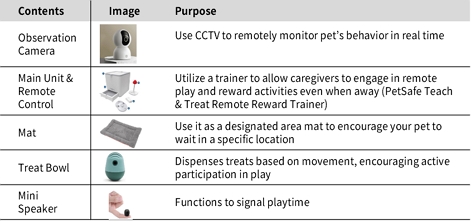
Prototype components for user environment testing
그림 2에서는 사용자 환경 테스트를 도식화한 모습이다. 본격적인 테스트 단계에서는 보호자가 CCTV를 통해 반려견의 행동을 원격으로 관찰하고(Observation), 놀이 기구(Play device)를 통해 전달되는 신호에 반려견이 자율적으로 반응(Response)하는지를 평가하였다. 반려견이 적절한 행동을 수행하면 보상 시스템(Dispenser)을 통해 자동으로 간식이 제공(Reward/supply)되어 놀이 행동의 긍정적 강화와 자발적 참여를 촉진하였다. 이러한 구성은 보호자의 부재 상황에서도 반려견이 능동적으로 놀이를 지속할 수 있는 환경을 조성하는 데 중점을 두었다. 사용자 인터뷰를 바탕으로 보호자 부재 시 반려견의 불안과 지루함을 해소하기 위한 세 가지 자율적 놀이 유형을 선정하였다.
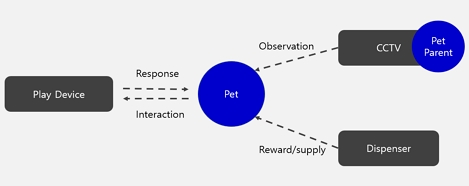
User environment test configuration
'지정 장소 테스트'는 특정 장소로의 이동과 대기 행동을 촉진하며, '사운드 후 특정 행동 테스트'는 소리 신호에 따른 행동 반응을 평가하였다. 마지막으로 '터치 후 보상 테스트'는 반려견이 자발적으로 물체를 터치하여 능동적인 놀이 참여도를 확인하는 방식으로 구성되었다. 그림 3은 실제 실험에 사용된 프로토타입을 통해 3일간 진행된 사용자 환경 테스트의 전반적인 구성과 과정을 시각적으로 요약한 이미지이다.
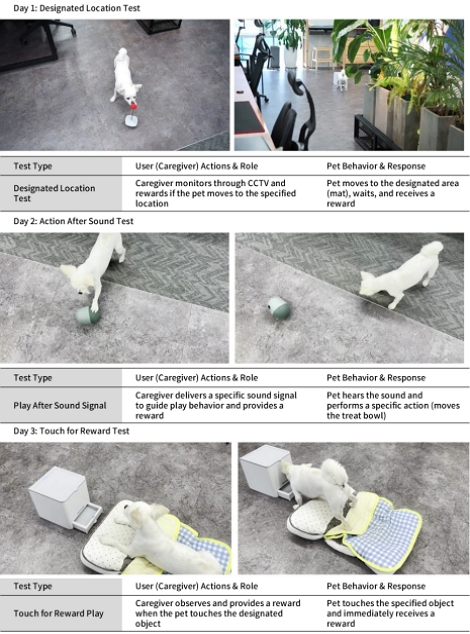
Results of prototype user environment testing and analysis of dog behavior
총 3일간 독립적으로 각기 다른 놀이 테스트가 진행되었다. 1일차는 지정 장소 테스트로, 반려견이 지정된 장소로 이동하면 리모콘을 통해 즉시 보상을 지급하였다. 2일차는 특정 소리 신호 후 간식 볼을 움직이면 보상하는 테스트였으며, 3일차는 특정 물체를 터치하면 보상을 제공하는 방식이었다. 각 테스트는 Test execution status (O: Success, △: Partial success, X: Failure) 분석하고, 형동 변화와 특징을 표 9에 요약하였다.
Integrated evaluation of user environment test using prototype over 3 days
각 테스트는 10분 초기 훈련 후 60분 동안 10분 단위로 반복 진행되었고, 반복된 실험을 통해 반려견의 수행 능력은 점진적으로 향상되었다. 다만 반려견의 성격과 특성에 따라 초기 훈련 시간이 더 필요할 수 있으며, 보호자의 적극적 참여가 필수적이었다.
3.6 결과 분석 및 디자인 방향 설정
사용자 환경 테스트 결과, 각 놀이 유형은 반려견의 자율적 참여와 문제 행동 개선에 점진적인 효과를 나타냈다. 특히 ‘지정 장소 놀이’는 초기 집중력 부족으로 수행이 어려웠지만, 반복 학습을 통해 안정적인 대기와 장소 유지가 가능해졌다. ‘사운드 후 특정 행동 놀이’는 소리 인지 및 반응에 시간이 걸렸으나, 보상과의 연관성을 인식하면서 행동 수행률이 점차 향상되었다. ‘터치 후 보상 놀이’는 상대적으로 빠르게 학습되었고, 반복을 통해 즉각적 행동 반응과 보상 기대감이 강화되었다.
아울러 반려견의 행동을 인식하여 즉각적으로 간식을 제공하는 자동 보상 시스템 도입은 자발적 놀이 참여를 유도하는 핵심 기능으로 확인되었으며, 테스트 결과에서도 보상 제공과 놀이 반응 간의 강한 상관관계가 관찰되었다.
실험 결과를 바탕으로 도출된 디자인 방향은 표 10과 같은 다섯 가지로 요약할 수 있다. 첫째, 반려견의 자율적인 참여를 유도하기 위해 기다리기, 소리 반응, 접촉 보상 등을 중심으로 한 능동적 놀이 시나리오를 구성하여 지속 가능한 놀이 콘텐츠를 개발하는 것이 필요하다. 둘째, 보호자의 부재 상황에서도 반려견의 행동을 실시간으로 관찰하고 놀이를 유도할 수 있도록 IoT 기반의 원격 상호작용 및 모니터링 기능을 갖춘 시스템이 설계되어야 한다. 셋째, 반려견의 특정 행동을 인식하고 센서를 통해 자동으로 간식을 제공하는 보상 시스템은 놀이 참여도를 높이는 핵심 요소로 작용하며, 사용자가 보상 빈도나 방식 등을 설정할 수 있도록 맞춤형 기능이 필요하다. 넷째, 제품은 장기 사용에 견딜 수 있는 구조적 안정성과 내구성을 확보해야 하며, 반려견의 물리적 활동에 안전하게 대응할 수 있는 소재 선택이 중요하다. 마지막으로, 보호자 편의를 고려해 직관적인 UI를 갖춘 앱 인터페이스와 감성적이며 미니멀한 외형 디자인을 적용함으로써, 가정 내 환경과 자연스럽게 조화를 이루는 사용자 친화적인 제품이 되어야 한다.
Result analysis and design direction establishment
Ⅳ. 사용자 중심 콘텐츠 제작 및 시스템
4.1 브랜드 ‘PEMBER’ 디자인 컨셉과 브랜드 아이덴티티
본 연구에서 개발한 브랜드 ‘PEMBER’는 ‘Pet’과 ‘Member’의 합성어로, 반려견이 단순히 돌봄의 대상이 아니라 보호자와 동등한 가족 구성원으로 인식된다는 펫 휴머니제이션의 가치를 담고 있다. 그림 4는 이러한 브랜드 콘셉트를 시각적으로 표현한 것이다.

PEMBER brand concept
브랜드 ‘PEMBER’의 핵심 디자인 컨셉은 Connected Companion(연결된 동반자)으로 정의하였다. 이는 IoT 기술을 통해 보호자와 반려견 사이의 물리적 거리와 관계없이 지속적이고 긴밀한 소통과 상호작용을 가능하게 하겠다는 브랜드의 비전을 나타낸다. 그림 5는 이러한 브랜드 철학과 방향성을 시각적으로 종합한 이미지이다.
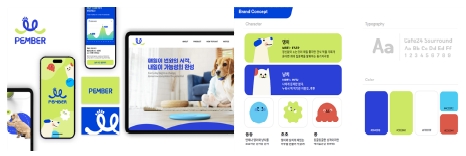
PEMBER Brand Identity (BI)
4.2 IoT 기반 놀이 기기 제품 구성 및 기능 설계
사용자 요구 분석과 인터뷰 결과를 기반으로 IoT 기반의 놀이 기기와 콘텐츠를 설계하였다. PEMBER 시스템은 정보의 중심 허브 역할을 수행하는 마스터(Master, 게이트웨이)를 중심으로 설계되었으며, 주변 기기와의 연결을 통해 다양한 놀이 시나리오를 지원한다. 이 그림 6은 PEMBER 시스템의 기술적 구성도를 시각적으로 나타낸 것이다. 전체 구조는 중앙 애플리케이션(APP)을 중심으로, 여섯 가지 스마트 반려견 기기들이 BLE(Bluetooth Low Energy) 또는 Wi-Fi를 통해 서버 및 앱과 연동되는 방식으로 구성되어 있다.
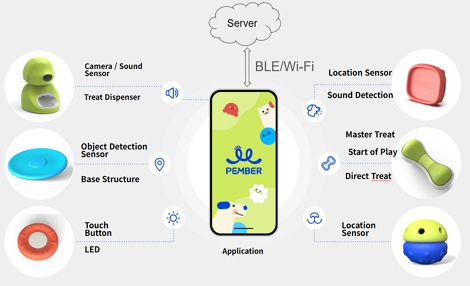
Technical diagram of PEMBER
Master 기기는 주변 환경의 소음 측정, 간식 배출 및 보상 사운드 재생, 그리고 실시간 영상 촬영과 같은 핵심 기능을 수행하여 보호자와 반려견 간의 원격 상호작용을 지원한다. 놀이 제품(Active play toy)은 Place, Ball, Touch로 구성되어 각 제품이 독립적이면서도 상호 연동되어 다양한 놀이 콘텐츠를 구현할 수 있도록 하였다. Switch는 보호자가 원격에서 Master와 연동하여 간식 제공과 놀이 시작 신호를 전달할 수 있게 하였고, Collar는 반려견의 신체 상태 및 움직임, 위치 추적, 짖음 소리 감지, 활동 패턴 분석, 측정(Mesurement) 등의 기능을 수행하여 보호자가 반려견의 상태를 실시간으로 모니터링할 수 있도록 지원한다. 장치의 데이터는 실시간으로 서버에 저장되어 사용자가 어플리케이션으로 확인이 가능하다. 위 시스템 구성도는 아래 그림 7과 같다.
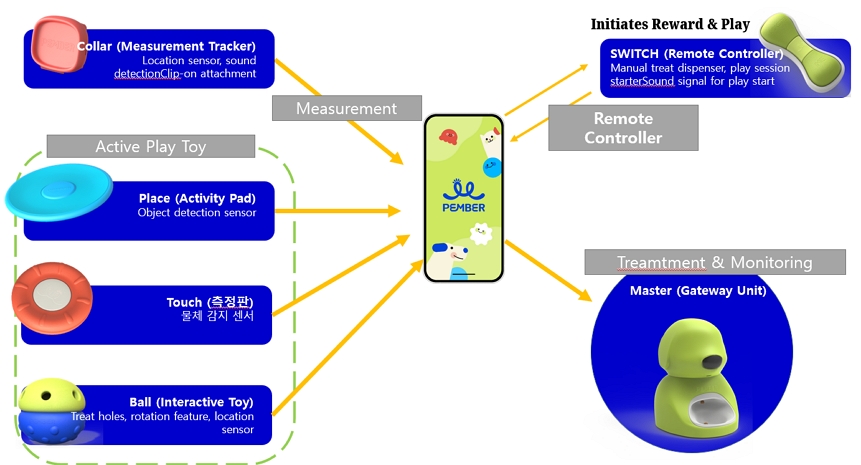
PEMBER system configuration
이러한 제품 구성과 기능은 사용자 인터뷰에서 도출된 요구사항인 지속적 흥미 유발, 원격 모니터링, 자동 보상 시스템, 내구성 및 안전성, 사용자 친화적 디자인 등을 반영하여 설계된 결과이다. 아래는 PEMBER 제품군의 각 구성 요소별 기능과 역할을 정리한 표이다. 각 제품의 개별적인 기능은 물론, 서로 연동되어 다양한 혼합 기능을 통한 놀이 콘텐츠 확장성을 제공한다.
4.3 놀이 콘텐츠 구현 및 시스템
테스트 결과를 바탕으로 PEMBER는 다양한 놀이 시나리오로 콘텐츠를 확장하여 구현하였다. 기본적인 행동 유도와 보상을 활용한 간단한 레벨부터 점차 난이도를 높인 놀이 콘텐츠로 구성되었으며, 주요 놀이 방식은 지정된 장소를 인지하고 반응하는 Place 놀이, 특정 물체를 인식하여 이동시키는 Ball-Place 놀이, 터치 센서의 색상에 반응하여 동일 색상을 맞추는 Touch 놀이 등으로 구성하였다. 각 놀이 유형은 실험을 통해 반려견의 정확한 행동 반응과 흥미를 유도하는 데 성공하였으며, 이를 통해 놀이 난이도와 복잡성을 체계적으로 확장할 수 있었다. 제품의 세부 기능은 그림 8에, 놀이 방법에 대한 설명은 그림 9에 제시하였다.
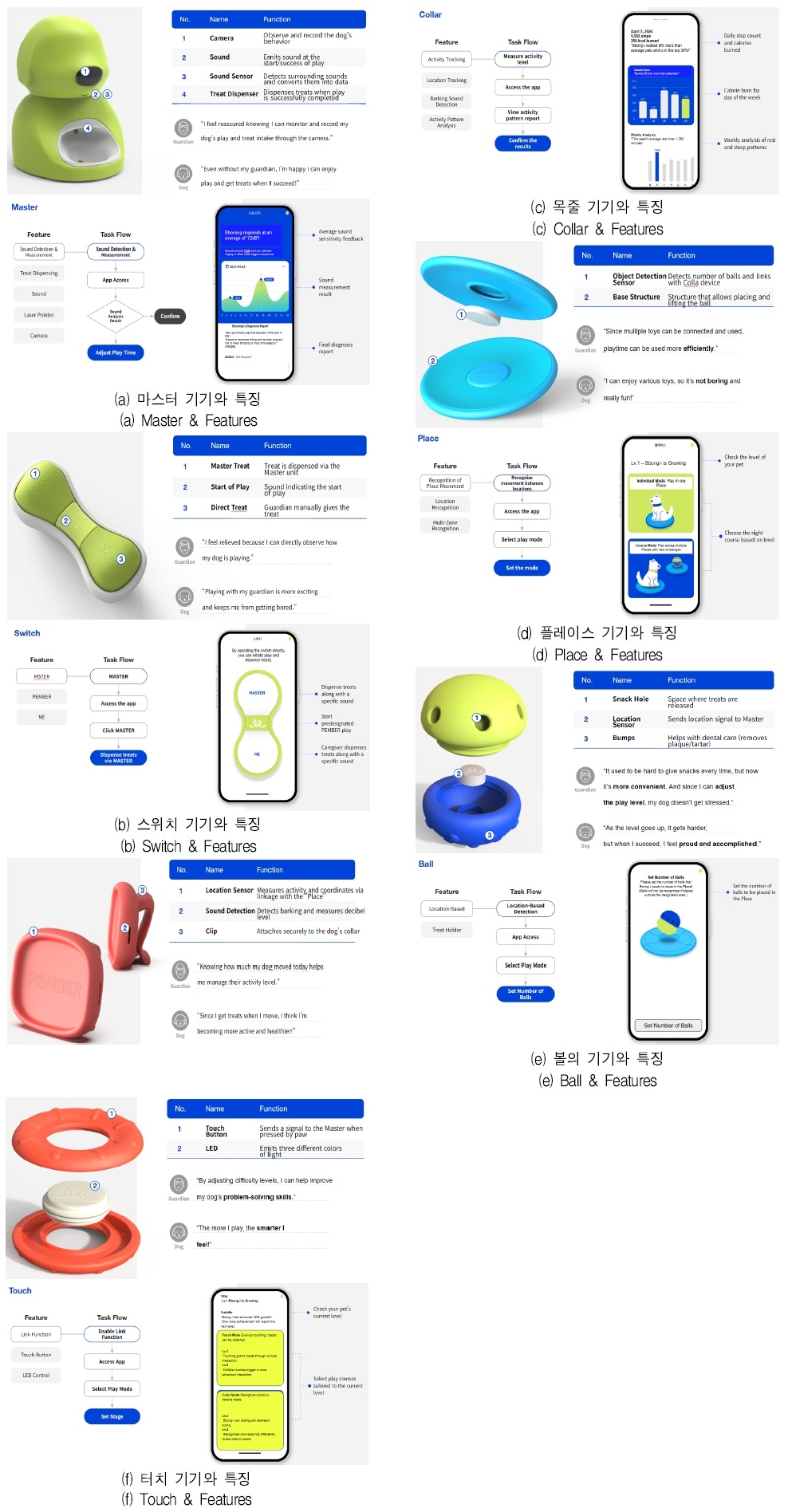
Product types and key features
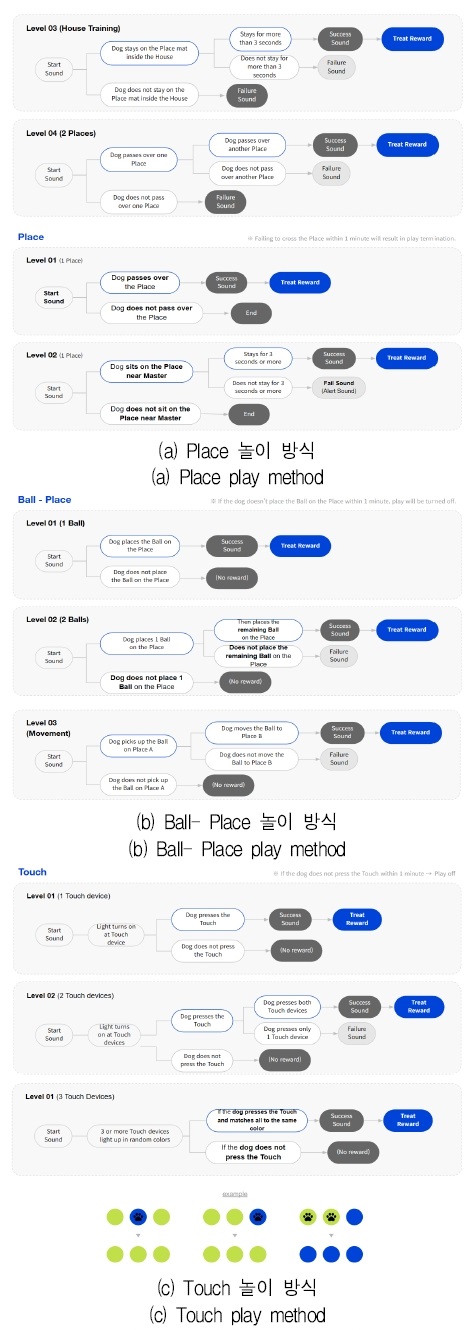
Dog play content scenarios and level configuration using prototypes
이러한 콘텐츠의 체계적 구현은 보호자와 반려견 간의 상호작용을 더욱 풍성하게 만들고, 반려견의 신체적, 인지적 발달을 촉진하는 데 기여할 수 있도록 설계되었다.
Ⅴ. 결과 및 논의
5.1 제품 및 콘텐츠 실험 결과 요약 및 분석
본 연구에서는 사용자 중심의 IoT 기반 반려견 놀이 제품과 브랜드 ‘PEMBER’를 개발하기 위해 초기 프로토타입을 제작하고, 사용자 환경 테스트를 수행하여 제품의 기능성과 유효성을 검증하였다. 지정 장소 반응, 소리 신호 반응, 터치 보상의 세 가지 핵심 놀이 유형 테스트를 각기 독립된 날에 걸쳐 실시하였다. 매일 10분간의 집중적 훈련을 통해 반려견이 놀이 규칙을 익힌 후, 연속적으로 60분 동안 10분 단위로 반복 테스트를 진행하였다. 실험 결과, 초기에는 수행률이 낮았으나 반복적인 학습을 통해 후반부로 갈수록 반려견의 수행률이 현저히 향상되는 것을 관찰하였다. 이는 놀이의 난이도 조절과 반복적 보상 시스템이 반려견의 학습 능력을 촉진하고 자발적 참여를 유도할 수 있음을 보여준다. 또한 리모컨을 활용한 원격 조작 방식이 보호자 부재 시에도 반려견의 흥미와 활동성을 유지하는 데 효과적이라는 점을 확인하였다. 그러나 실험 과정에서 훈련 초기 단계에 보호자의 집중적인 참여가 절대적으로 필요하며, 반려견의 성향과 학습 속도에 따라 훈련 기간이 연장될 수 있다는 점도 드러났다. 이는 사용자 교육과 제품 사용 가이드 개발의 중요성을 시사한다.
5.2 논의 및 제언
본 연구는 보호자의 부재 환경에서도 반려견이 자율적으로 놀이에 참여할 수 있도록 IoT 센서 기반의 스마트 반려견 놀이 시스템을 제안하였다. 시스템은 플레이 모듈, 간식 보상기, 위치 기반 센서, LED 인터페이스, 모바일 연동 애플리케이션으로 구성되며, 반려견의 행동 패턴을 실시간 감지하여 적절한 반응(예: 간식 제공, 불빛 변화, 사운드 출력)을 유도하도록 설계되었다. 이러한 구성은 단순한 장난감을 넘어, 자율적 놀이 수행을 위한 플랫폼으로 기능한다.
제품 및 콘텐츠 디자인은 사용자 인터뷰를 통해 추출된 세 가지 놀이 유형(탐색 놀이, 위치 기반 놀이, 터치 놀이)을 반영하였으며, 각각의 유형은 놀이 난이도에 따라 세분화되어 있으며 기기의 물리적 구조 및 소프트웨어 로직에 통합되었다. 사용자 분석을 통해 놀이 시스템을 구현하고, 실제 실험을 통해 가능성을 확인하였다.
그러나 실험 설계의 제한점도 존재한다. 본 연구의 실험은 단일 견종(믹스견, 4세)을 대상으로 3일간의 짧은 시간 동안 진행되었으며, 매일 10분간의 초기 훈련과 60분의 관찰로 구성되었다. 이에 따라 놀이 행동의 변화가 일정 부분 관찰되었으나, 다양한 견종 및 연령, 크기, 성격을 포함한 집단을 대상으로 한 장기적이고 통계적인 실험 결과를 확보하기에는 한계가 있었다.
향후 연구에서는 시스템 기술 구조의 전문성 강화를 위해 센서 사양, 간식 분사 구조, LED 출력 로직, 통신 방식, 전원 공급 및 제어 로직, 데이터 흐름 구조 등의 핵심 기술 정보를 구체화하고 도식화할 예정이며, 다양한 견종과 사용자 환경을 반영한 장기적 실험 설계를 통해 놀이 지속성, 학습 효과, 사용자 만족도 등을 통계적으로 분석할 계획이다. 또한 반려견 개체별 차이를 고려한 개인화 콘텐츠 설계를 위해 행동 데이터를 기반으로 한 맞춤형 난이도 조정 알고리즘을 도입함으로써, 반려견의 자율적 참여를 더욱 효과적으로 유도하고자 한다. 이러한 후속 연구는 본 시스템의 상용화 가능성을 높일 뿐 아니라, 보호자 부재 환경에서도 반려견의 삶의 질을 향상시킬 수 있는 실질적 기초 자료로 활용될 수 있을 것이다.
References
-
G. Flannigan and N. H. Dodman, "Risk factors and behaviors associated with separation anxiety in dogs", Journal of the American Veterinary Medical Association, Vol. 219, No. 4, pp. 460-466, Aug. 2001.
[https://doi.org/10.2460/javma.2001.219.460]

-
F. D. McMillan, "Stress-induced and emotional eating in animals: A review of the experimental evidence and implications for companion animal obesity", Journal of Veterinary Behavior, Vol. 8, No. 5, pp. 376-385, Sep. 2013.
[https://doi.org/10.1016/j.jveb.2012.11.001]
- KB Financial Group Management Research Institute, "2023 Korea Pet Report: Pet Preparation and Health Care", https://www.kbfg.com, [accessed: Mar. 01, 2024]
-
C. Ferencz-Flatz, "Humanizing the animal, animalizing the human: Husserl on pets", Human Studies, Vol. 40, No. 2, pp. 217-232, Jun. 2017.
[https://doi.org/10.1007/s10746-017-9429-9]
-
U. O. Boya, M. J. Dotson, and E. M. Hyatt, "Dimensions of the dog-human relationship: A segmentation approach", Journal of Targeting, Measurement and Analysis for Marketing, Vol. 20, No. 2, pp. 133-143, Apr. 2012.
[https://doi.org/10.1057/jt.2012.8]
-
A. Chen, K. P. Hung, and N. Peng, "A cluster analysis examination of pet owners’ consumption values and behavior: Segmenting owners strategically", Journal of Targeting, Measurement and Analysis for Marketing, Vol. 20, No. 2, pp. 117-132, Apr. 2012.
[https://doi.org/10.1057/jt.2012.10]
-
L. R. Kogan, P. W. Hellyer, M. Rishniw, and R. Schoenfeld-Tacher, "Veterinary behaviorists’ assessment of dog behavior problems and treatment methods", Journal of Veterinary Behavior, Vol. 16, pp. 33-37, Jul. 2016.
[https://doi.org/10.1016/j.jveb.2016.03.006]
-
M. Bekoff, "Playful fun in dogs", Current Biology, Vol. 25, No. 1, pp. R4-R7, Jan. 2015.
[https://doi.org/10.1016/j.cub.2014.09.007]
-
R. Sommerville, E. A. O’Connor, and L. Asher, "Why do dogs play? Function and welfare implications of play in the domestic dog", Applied Animal Behaviour Science, Vol. 197, pp. 1-8, Sep. 2017.
[https://doi.org/10.1016/j.applanim.2017.08.001]
-
L. Handlin, E. Hydbring-Sandberg, A. Nilsson, M. Ejdebäck, A. Jansson, and K. Uvnäs-Moberg, "Short-term interaction between dogs and their owners: Effects on oxytocin, cortisol, insulin and heart rate", Anthrozoös, Vol. 24, No. 3, pp. 301-315, Sep. 2011.
[https://doi.org/10.2752/175303711X13045914865385]
-
M. Nagasawa, S. Mitsui, S. En, N. Ohtani, M. Ohta, Y. Sakuma, and T. Kikusui, "Oxytocin-gaze positive loop and the coevolution of human-dog bonds", Science, Vol. 348, No. 6232, pp. 333-336, Apr. 2015.
[https://doi.org/10.1126/science.1261022]
-
D. L. Wells, "A review of environmental enrichment for kenneled dogs (Canis familiaris)", Applied Animal Behaviour Science, Vol. 85, No. 3-4, pp. 307-317, Jun. 2004.
[https://doi.org/10.1016/j.applanim.2003.11.005]
- J. Lee, H. Kim, and J. Park, "Global pet-tech market analysis: Trends, forecasts, and implications", International Journal of Industry Research, Vol. 15, No. 1, pp. 42-59, Jan. 2024.
-
H. Jeong, J. Kim, and Y. Choi, "The impact of IoT pet products on pet owners' perceived stress and pet anxiety", Computers in Human Behavior, Vol. 129, pp. 1-10, Jan. 2022.
[https://doi.org/10.1016/j.chb.2021.107128]
-
S. J. Hong, S. H. Kim, and H. S. Kang, "AI-driven behavior analysis and anomaly detection system for pets", Journal of Veterinary Behavior, Vol. 38, pp. 15-22, Jun. 2020.
[https://doi.org/10.1016/j.jveb.2020.02.004]
-
Y. Ding, J. Ma, Q. Zhang, and X. Li, "Enhancing pet welfare through smart IoT-based care solutions: A review", Animals, Vol. 11, No. 12, pp. 1-17, Dec. 2021.
[https://doi.org/10.3390/ani11123437]
- D. A. Norman, "The Design of Everyday Things: Revised and Expanded Edition", Basic Books, pp. 1-300, Nov. 2013.
- International Organization for Standardization, "ISO 9241-210:2019 – Ergonomics of human-system interaction – Part 210: Human-centred design for interactive systems", https://www.iso.org/standard/77520.html, [accessed: Mar. 01, 2024].
-
M. Maguire, "Methods to support human-centred design", International Journal of Human-Computer Studies, Vol. 55, No. 4, pp. 587-634, Oct. 2001.
[https://doi.org/10.1006/ijhc.2001.0503]
-
N. J. Rooney and J. W. S. Bradshaw, "An experimental study of the effects of play upon the dog–human relationship", Applied Animal Behaviour Science, Vol. 75, No. 2, pp. 161-176, Feb. 2002.
[https://doi.org/10.1016/S0168-1591(01)00197-9.]
-
S. Duranton and A. Horowitz, "Let me sniff! Nosework induces positive judgment bias in pet dogs", Applied Animal Behaviour Science, Vol. 211, pp. 61-66, May 2019.
[https://doi.org/10.1016/j.applanim.2018.12.009]
-
N. W. Milgram, B. D. Head, A. Zicker, and C. Ikeda-Douglas, "Learning ability in aged beagle dogs is preserved by behavioral enrichment and dietary supplementation", Neurobiology of Aging, Vol. 26, No. 1, pp. 77-90, Jan. 2005.
[https://doi.org/10.1016/j.neurobiolaging.2004.02.014]

2010년 2월 : 백석대학교 산업디자인(학사)
2017년 2월 : 홍익대학교 디자인경영(석사)
2017년 11월 ~ 현재 : 코아이디(종합디자인전문회사) 대표
관심분야 : 사물인터넷, AI, 정보시각화